In brief
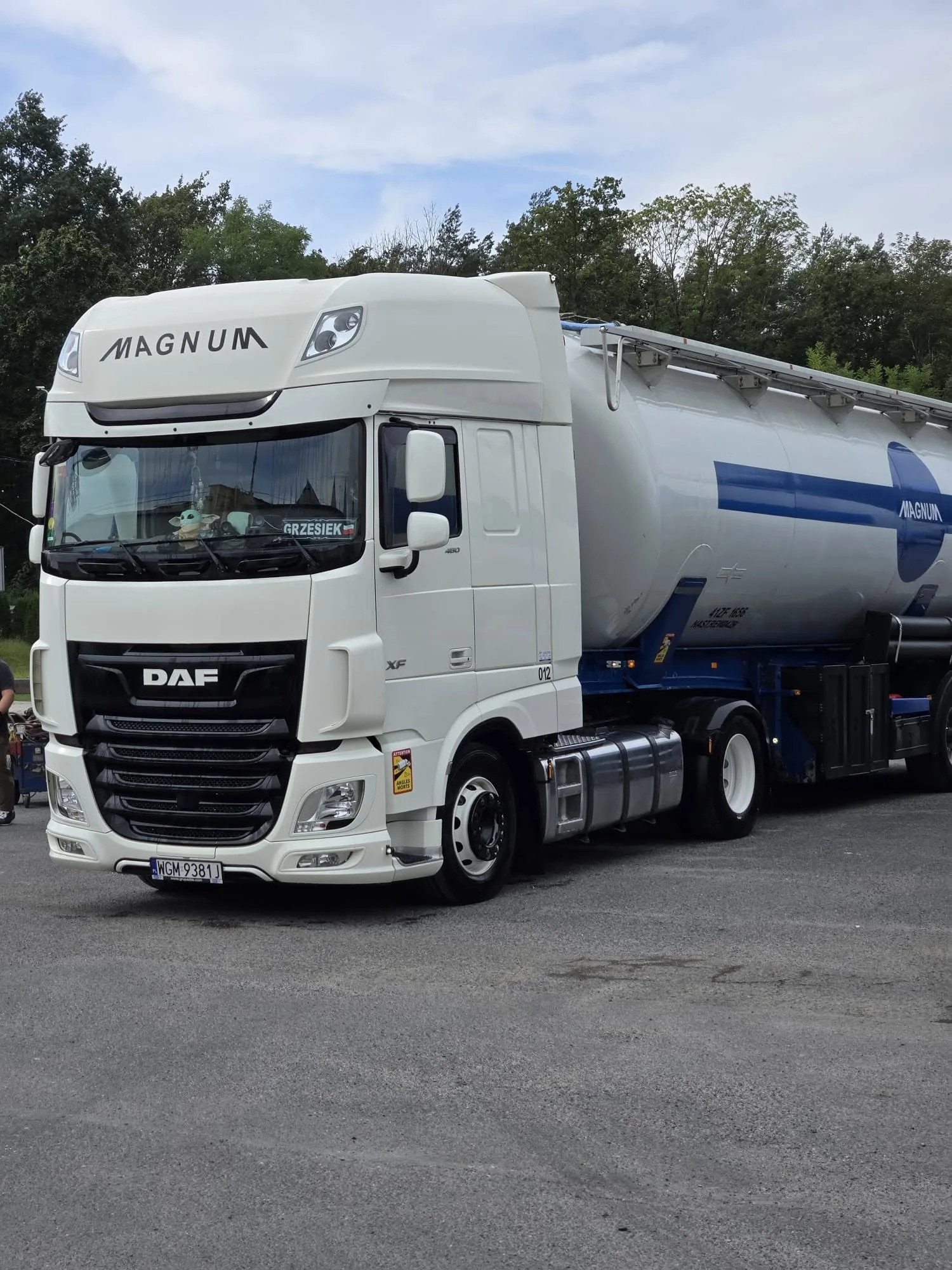
Silo transport is the carriage of dry bulk materials in pressure tanks on trailers. A 55–65 m³ silo trailer takes 25–27 tonnes of granulate, and pneumatic unloading goes straight into the consignee’s silo. PHS Magnum serves routes across the entire European Union — with the main directions to Germany, Austria, Czechia and the Benelux countries — with a fleet of 26 DAF XF 480 Euro 6 tractors and 31 silo trailers, based 4 km from the A4 motorway.
Need to move bulk material? Order silo transport → — a quote the same working day.
What silo trailer transport is
A silo trailer (German: Siloauflieger) is a trailer with a cylindrical tank designed to carry dry bulk materials. From loading to unloading the material stays in a closed chamber — with no contact with moisture, dust or contamination. That is the key advantage over carriage in big-bags on a curtainsider.
Unloading is pneumatic: the compressor builds a working pressure of approx. 1.8–2 bar, air flows through the aeration pads at the bottom of the tank and fluidises the material, which flows through a hose (Storz or PERROT couplings) into the consignee’s factory silo. Full unloading of 25 tonnes usually takes 45–120 minutes, depending on the material and the receiving installation.
Silo transport is the standard wherever the consignee has its own storage silos: in plastics converting, the chemical and paper industries, and environmental protection (sorbents, lime for flue gas cleaning). A full description of the service and the list of 18 handled materials can be found on the bulk material transport page.
The logistics model is simple and precisely for that reason effective: the producer loads the material by gravity from the factory silo through the trailer’s top manholes, the driver seals the manholes and documents the chamber’s cleanliness, and at the consignee the same material — intact, without re-handling and without disposable packaging — flows through a pipeline into the production silo. Zero bags, zero pallets, zero packaging waste and minimal contamination risk. In the era of EU environmental regulation, this is an argument that increasingly decides in favour of this form of delivery.
What is carried by silo
The catalogue of materials riding in silo trailers is broader than commonly assumed. The common denominator: the material must be dry, free-flowing and capable of fluidisation or free discharge. Below is an overview of the most important groups — with bulk density, real payload and the requirements the carrier must meet.
Polyethylene: LDPE, HDPE, LLDPE
Polyethylene is the most frequently transported polymer in Europe. LDPE (low-density polyethylene) with a bulk density of approx. 0.5–0.55 g/cm³ goes mainly to producers of film, coatings and flexible packaging. HDPE (0.5–0.6 g/cm³) goes to manufacturers of pipes, bottles, containers and injection-moulded products. LLDPE — linear low-density polyethylene — feeds the production of stretch and stretchable films.
All three variants fill the tank volume before reaching the weight limit: a 60–65 m³ trailer holds 25–27 tonnes. PE granulate is sensitive to surface moisture (processing problems), to dust from previous loads and to angel hair during too aggressive unloading. Market practice: trailers dedicated to polyolefins, a cleanliness protocol before every loading, unloading at a controlled velocity. We describe the specifics of this segment at EU scale in the article on PE/PP granulate transport by silo across Europe .
Polypropylene (PP)
Polypropylene — homopolymer (PP-H) and copolymers (PP-Co) — is the second pillar of silo transport. A bulk density of approx. 0.45–0.55 g/cm³ means that, like PE, it is limited by volume, not weight. Consignees are the automotive industry (interior components, bumpers), producers of rigid packaging, household appliances, nonwovens and BOPP.
PP is sometimes transported with additives (talc, glass fibre, stabilisers) already compounded into the granulate — such compounds have a higher bulk density and different fluidisation behaviour. PP converters are particularly sensitive to cross-contamination with coloured granulate: a few black pellets in a batch of natural PP can stop the acceptance of the entire delivery. Hence the iron rule of trailer dedication and documenting every wash.
Other polymers: PVC, PET, PS, PA
PVC in powder or granulate form (0.55–0.65 g/cm³) goes to producers of window profiles, pipes and flooring — it requires efficient aeration, because PVC powder cakes easily when moist. PET and PS (polystyrene) with a bulk density of 0.6–0.9 g/cm³ reach the weight limit before filling the tank. Polyamides (PA6, PA66) and polycarbonate are high-value engineering materials — strongly hygroscopic, carried with absolute chamber dryness and often with a cushion of dried air.
Regranulates and recyclates: R-PET, R-HDPE, R-PP
The fastest-growing segment, driven by EU regulation — the PPWR regulation, recyclate content targets in packaging and end-customer pressure. R-PET, R-HDPE, R-PP and R-PE flow from recyclers to converters under the same rules as virgin plastics, but with additional challenges: greater batch variability, more dust and fine fractions, varied granulation and bulk density (0.35–0.6 g/cm³ depending on the source).
For the carrier this means two things. First — chamber cleanliness control is even more important, because food-grade recyclate (e.g. R-PET certified for food contact) must not come into contact with residues of technical loads. Second — efficient aeration determines the unloading time, because dusty fractions fluidise more slowly. We dissect the impact of the new regulations on this segment in the articles on PPWR 2026 and recyclate transport and on the technical differences between R-PET and virgin PET .
From 2026 there is also Regulation EU 2025/2365 on pellet loss prevention — it imposes procedural obligations on shippers and carriers during loading and unloading. What specifically changes for shippers is described in our overview of granulate shippers’ obligations , and the practical side — in the silo trailer driver’s checklist .
Quicklime and hydrated lime
Two different materials, two different transport regimes. Quicklime (CaO) — the product of burning limestone — is highly reactive: contact with water triggers an exothermic slaking reaction. The bulk density of ground quicklime is approx. 0.9–1.1 g/cm³, so the trailer reaches the weight limit when only partially filled. The material is sometimes loaded warm, straight from the production line — the tank and seals must tolerate this. An absolute requirement: a completely dry chamber and tight manholes.
Hydrated lime (Ca(OH)₂) is lighter — 0.4–0.6 g/cm³ — and less reactive, but strongly dusting and alkaline. It is one of the basic sorbents in flue gas cleaning: consignees include power plants, waste incinerators, steelworks and treatment plants. The second big stream is water treatment and ground stabilisation. Both limes require reinforced aeration pads (the alkaline environment degrades the fabric faster than granulate does) and rigorous washing before the trailer returns to polymer loads — in practice it is better to keep separate trailers for minerals. More: mineral transport — lime, chalk, talc .
Chalk and limestone powder
Chemically it is the same calcium carbonate (CaCO₃), but commercially — two different products. Technical chalk (ground or precipitated) is a filler for plastics, paints, paper and rubber; what counts is purity, whiteness and particle size, and the bulk density ranges from 0.3–0.6 g/cm³ (precipitated variants) to 0.9–1.4 g/cm³ (ground). Limestone powder — more coarsely ground, with a density of 1.0–1.5 g/cm³ — goes to agriculture (soil de-acidification), road building (an additive to bituminous mixes) and power generation (wet desulphurisation).
For the carrier the key difference is the cleanliness requirements: chalk for plastics is treated almost like premium granulate (contamination = a complaint), fertiliser-grade powder is tolerant. Both materials are weight-limited, not volume-limited — a 60 m³ trailer runs with the full 25–27 tonnes at about half the tank filled.
Talc
Ground talc is a premium-class filler: it goes into PP compounds (automotive), paints and coatings, paper, ceramics and cosmetics. The bulk density depends strongly on the grinding grade — from approx. 0.4 g/cm³ for micronised variants to 0.85 g/cm³ for coarser ones. Micronised talc fluidises slowly and requires patient unloading with well-maintained aeration; at the same time it is very sensitive to colour contamination. Consignees of compounding-grade talc expect a washing protocol and often audit the trailers before the first run.
Bentonite
Bentonite — a montmorillonite clay with a bulk density of approx. 0.75–1.0 g/cm³ — has one property that defines its logistics: it absorbs water and swells. Moist bentonite in a silo trailer chamber can bind into a mass impossible to fluidise — unloading becomes physically impossible without a service intervention. That is why manhole tightness and dryness of the compressed air system are critical conditions here. Consignees: foundries (moulding sands), drilling (muds), construction (waterproofing barriers), producers of hygiene litters and sorption granulates.
Fly ash
Fly ash from power generation (certified to EN 450) is a full-value concrete additive — it travels by silo from power plants to ready-mix concrete plants and precast producers. A bulk density of 0.8–1.1 g/cm³ means weight-limited transport. Ash is fine, abrasive and dusty: it accelerates wear of the aeration pads, valves and manifold, and every leaky point in the installation dusts immediately. Trailers in ash rotation are treated as dedicated — a return to granulates would require industrial washing with a full inspection.
Other market segments
Silos also carry technical urea (strongly hygroscopic), carbon black (extremely staining — trailers practically unrecoverable for other loads), pulverised coal, bleaching earths (Tonsil) and rubber granulates. Separate niches are animal feed and feed components, flours and food materials (trailers with food-grade certification and food washing) and construction materials carried in cement silo trailers — a specialised segment with its own equipment, outside PHS Magnum’s specialisation. Our fleet focuses on granulates, recyclates and minerals, where chamber cleanliness and repeatable quality are what count.
Summary table: bulk density and the real load
| Material | Bulk density | Limited by | Typical load in 55–65 m³ | Key requirement |
|---|---|---|---|---|
| LDPE | 0.50–0.55 g/cm³ | volume | 25–27 t | chamber cleanliness, angel hair control |
| HDPE | 0.50–0.60 g/cm³ | volume | 25–27 t | chamber cleanliness |
| LLDPE | ~0.55 g/cm³ | volume | 25–27 t | chamber cleanliness |
| PP (homo/copo) | 0.45–0.55 g/cm³ | volume | 25–27 t | zero colour contamination |
| R-PET / R-HDPE / R-PP | 0.35–0.60 g/cm³ | volume/weight | 22–27 t | dust control, fraction segregation |
| Quicklime (CaO) | 0.9–1.1 g/cm³ | weight | full weight in ~30 m³ | dry chamber, temperature resistance |
| Hydrated lime | 0.4–0.6 g/cm³ | volume/weight | 22–27 t | reinforced aeration, tightness |
| Ground chalk | 0.9–1.4 g/cm³ | weight | full weight | cleanliness as for granulate |
| Limestone powder | 1.0–1.5 g/cm³ | weight | full weight | standard |
| Talc | 0.4–0.85 g/cm³ | grade-dependent | 22–27 t | slow fluidisation, cleanliness audit |
| Bentonite | 0.75–1.0 g/cm³ | weight | full weight | absolute dryness (swelling!) |
| Fly ash | 0.8–1.1 g/cm³ | weight | full weight | abrasion resistance, dedication |
The conclusion from the table: there is no single “silo trailer payload”. There is the bulk density of a specific batch and the resulting point at which the trailer hits the weight or volume limit. A reliable carrier asks about bulk density before quoting — not after loading.
Silo trailer construction — what a tank on wheels consists of
Understanding the silo trailer’s construction helps the shipper assess the condition of the equipment that arrives for their material. Below are the elements that determine delivery quality.
The pressure tank: aluminium or steel
The heart of the trailer is a cylindrical pressure tank with a capacity of 31–66 m³. The standard in granulate transport is aluminium: EN AW-5754/5083 alloys give a tank that is light (the whole trailer’s tare weight 5.5–7 t), corrosion-resistant and chemically neutral to polymers. Low tare weight translates directly into payload — every tonne saved on the structure is a tonne more material at the 40 t GVW.
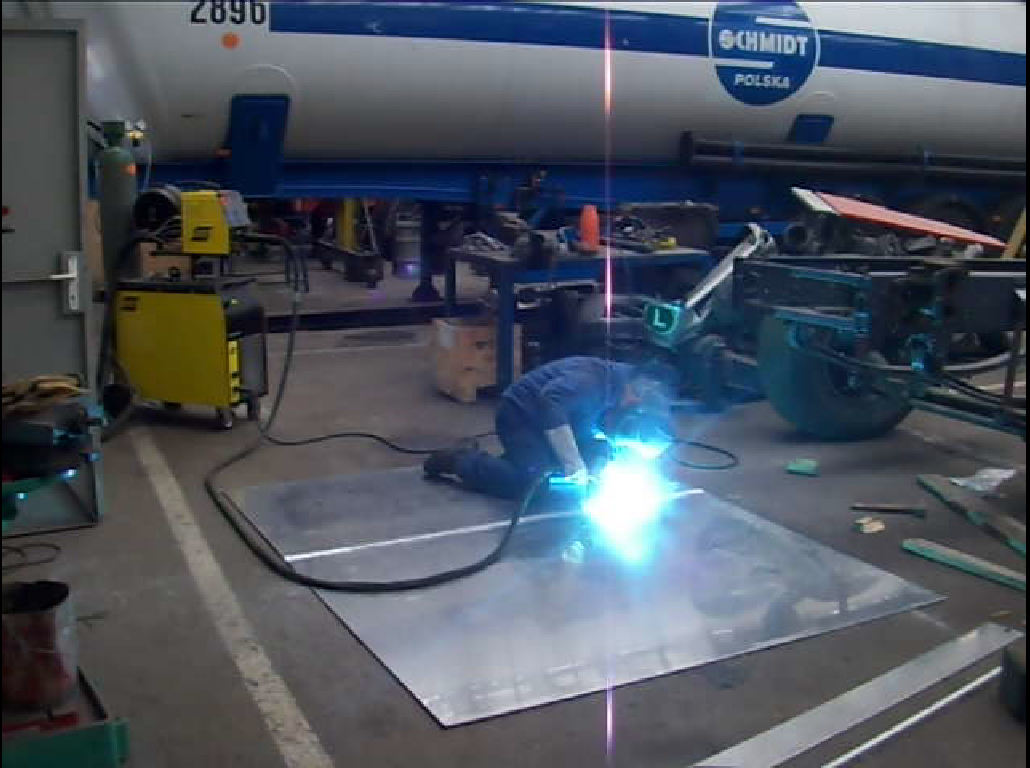
Steel and stainless steel appear with chemically aggressive media, higher working pressures and in some food applications. A steel tank is heavier, but easier to repair by welding and more mechanically resistant. The choice of tank material also affects the TDT inspection schedule — the inspector takes it into account in the approval decision.
Chambers, cones and filling manholes
The tank is divided into chambers — from one (the classic “cigar” for large batches of a single material) to three or four (multi-chamber trailers, allowing several batches or materials to be carried simultaneously). Each chamber has a filling manhole on top (DN 400–500) with a gasket and closure, and at the bottom a discharge cone with a 45–60° angle, ensuring gravity flow of the material towards the outlet.
The condition of the manhole gaskets is one of the simplest and most often overlooked inspection points: a hard, cracked gasket means moisture in the chamber during rain and condensation on the cargo. For hygroscopic materials — urea, polyamide, bentonite — that is a straight road to a complaint.
Aeration pads and the fluidisation system
At the bottom of each cone work the aeration pads (fluidising mats) — permeable textile membranes through which compressed air enters the material and turns it into a “liquid” suspension capable of pipeline transport. This is a wear item: the fabric clogs over time, hardens and loses permeability, and then unloading stretches from one hour to three, or stops halfway.
The symptoms of worn aeration are characteristic: uneven emptying of the chambers, material “spitting” instead of flowing smoothly, tonnes of residue at the bottom of the cone that cannot be blown out. Pad replacement is a standard service item — details and selection in the aeration pads section.
The manifold, valves and discharge fittings
The cone outlets are connected by a manifold — a horizontal collecting pipe leading to the discharge outlet at the rear of the trailer. Along the material’s path work the valves (butterfly or ball, pneumatically or manually operated) that open successive chambers, plus a valve regulating the air split between bottom aeration and the top cushion (overpressure above the material that “pushes” the load along).
The discharge outlet ends in a Storz or PERROT coupling (most often DN 100) — two competing quick-coupling standards that must match the consignee’s installation. We describe the differences, applications and typical compatibility problems in the article on PERROT and Storz discharge couplings . The fittings are completed by a pressure gauge, a safety valve (opens when the permissible pressure is exceeded, usually 2.0–2.5 bar) and an air filter. An overview of types and replacements — in the silo trailer valves section.
The compressor, PTO and air source
The unloading air is most often supplied by a screw compressor driven from the tractor’s PTO (power take-off) — the driver engages the PTO and the tractor’s engine works as the compressor drive throughout the unloading. Alternatives: a compressor with its own auxiliary engine on the trailer, or a stationary compressed air installation at the consignee (then the trailer connects to the plant network).
The condition of the compressor and the air cooler affects not only the unloading time but also quality: overheated air can partially melt sensitive granulates, and moist air (a faulty water separator) can dampen a hygroscopic load on the last metres of its journey.
The nameplate and tank documentation
Every pressure tank has a nameplate: manufacturer, serial number, year of construction, capacity, permissible and test pressure, operating temperature. It is the tank’s identity card — the nameplate data must match the inspection book and the TDT approval decision. When buying a used trailer or auditing a carrier, verifying this triad (nameplate — book — decision) is the first step. An illegible or welded-over nameplate is a red flag.
Types of silo trailers and the mechanics of unloading
Pneumatic vs gravity
| Feature | Pneumatic silo trailer | Gravity silo trailer (kippsilo) |
|---|---|---|
| Unloading | compressed air, aeration pads | tank raised, gravity outflow |
| Discharge direction | upwards by hose, into a silo | downwards, into a receiving hopper |
| Materials | powders, granulates, dusty materials | granulates, pellets, coarse materials |
| Unloading time for 25 t | 45–120 min | 20–40 min |
| Requirements at the consignee | silo inlet + air line or vehicle compressor | underground hopper / tipping station |
| Technical supervision | TDT (pressure tank) | depending on the design |
In practice, pneumatic trailers dominate the Polish-German granulate market — because consignees receive material into vertical silos. The differences between a silo trailer and a tanker for liquid cargo are described in detail in the article tanker vs silo trailer .
How pneumatic unloading works — step by step
The mechanism has two stages. First, fluidisation: the compressor forces air under the aeration pads; passing through the membrane, the air separates the grains of material and suspends them in the stream — the bulk load starts to behave like a liquid. In parallel, overpressure builds above the material (1.8–2.0 bar working), pushing the suspension through the open cone valve into the manifold and onwards, up the hose, into the consignee’s silo.
The driver manages the process with the valves: opens the chambers sequentially, balances the top and bottom air depending on the material’s behaviour, watches the pressure gauge. Unloading ends with a “blow-through” — the material residues from the manifold and hose are blown into the silo so that no material remains in the installation to contaminate the next load. The consignee’s silo must have a working venting filter: all the conveyed air must escape from the silo, and a clogged filter means rising pressure and a real risk of damage to the receiving installation.
Kippsilo — faster, but not everywhere
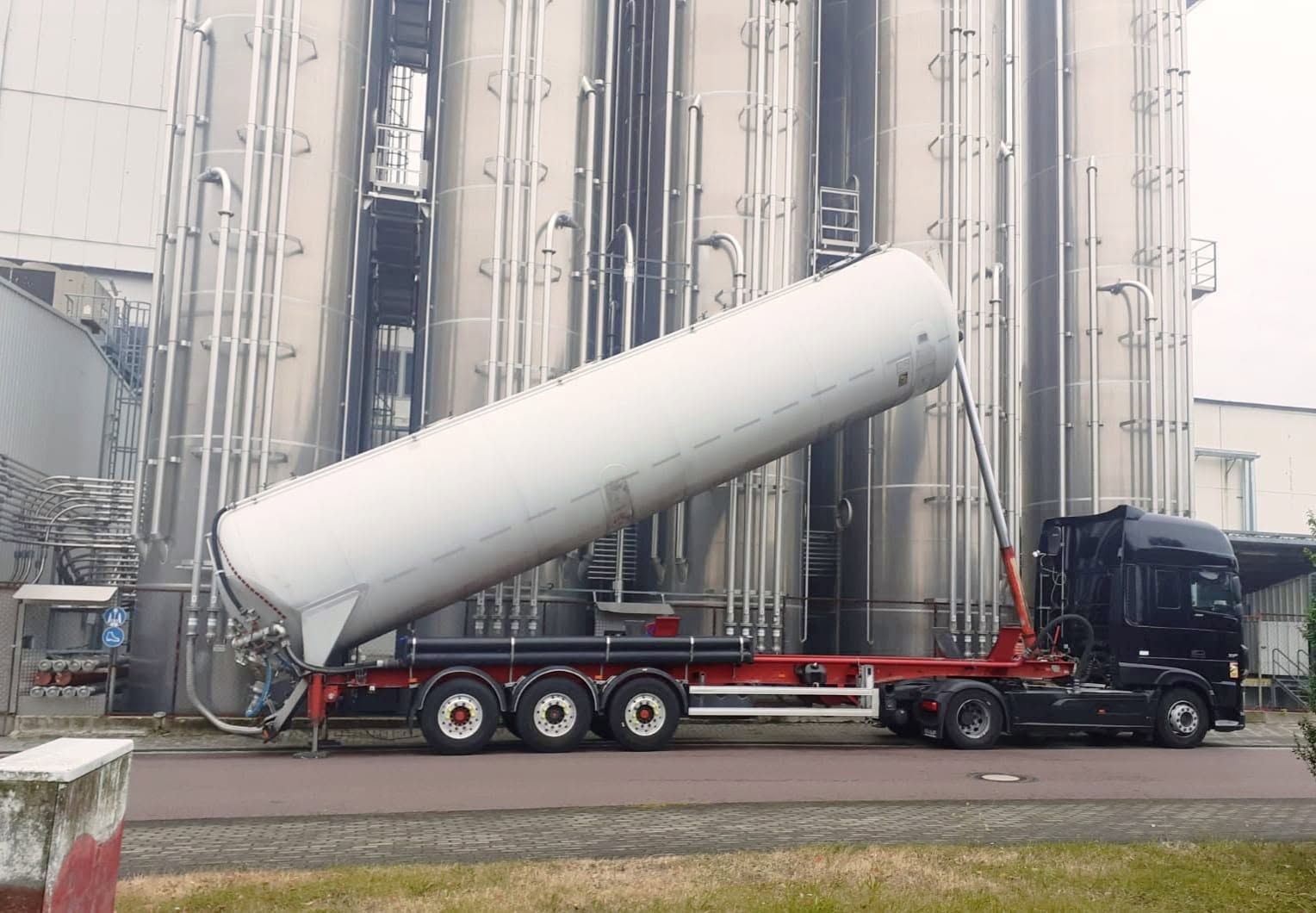
A gravity trailer works like a tipper with a tank: a hydraulic cylinder raises the tank to approx. 45–50°, and the material flows out through the rear outlet into the receiving hopper. Advantages: pace (20–40 minutes), no contact between the material and a stream of compressed air (zero angel hair), a simpler design. Disadvantages: the consignee must have a hopper or a tipping station, and the raised tank requires a hard, level surface and considerable height — unloading under power lines or in a low hall is out.
Angel hair and fractionation — the dark side of pneumatics
Two phenomena spoil granulate quality during pneumatic unloading. Angel hair: at too high a conveying velocity, the pellets slide along the pipeline walls, friction locally melts the polymer and draws thin threads and streamers out of it. The threads clump together, clog the silo filters and disqualify the material for demanding applications. Prevention: control of the flow velocity (more material, less air in the stream), large-radius pipeline bends, appropriate pipe surfaces on the consignee’s side.
Fractionation is the segregation of a batch during pneumatic conveying: dust and fine fractions travel differently from full pellets, so the beginning and end of unloading may differ in particle size composition. For most applications this is negligible, but precision converters (thin films, medicine) can specify a maximum fine fraction share — and then the carrier’s unloading discipline becomes a quality parameter of the delivery.
55–65 m³ capacity vs payload — density decides
A silo trailer has two limits: the tank volume and the permissible gross combination weight (40 t GVW). Which limit kicks in first is decided by the material’s bulk density:
| Material | Bulk density | Limited by | Typical load |
|---|---|---|---|
| PE-LD, PP | ~0.45–0.55 g/cm³ | volume | 25–27 t in 60–65 m³ |
| PVC, PS, PA | ~0.55–0.70 g/cm³ | balance | 25–27 t |
| PET, R-PET | ~0.80–0.90 g/cm³ | weight | full 27 t in ~35 m³ |
| Hydrated lime | ~0.4–0.6 g/cm³ | volume/weight | batch-dependent |
| Pulverised coal | ~0.9–1.1 g/cm³ | weight | full weight, partial volume |
Practical conclusion: for light granulates the largest trailer (65 m³) pays off; for dense materials a smaller one is enough. A good carrier matches the trailer to the material specification, not the other way round. It is also worth remembering the tare weight calculation: a combination with a light aluminium trailer will take 1–2 tonnes more cargo than the same run with a steel trailer — on volume contracts that is a difference counted in dozens of runs per year.
The PHS Magnum fleet — 26 tractors, 31 silo trailers
PHS Magnum has run bulk material transport since the 1990s with its own fleet — no subcontractors. The current state of the fleet:
- 26 DAF XF 480 Euro 6 tractors — green sticker, entry into all Umweltzonen in Germany and Austria without restriction
- 31 silo trailers of 55–65 m³ (Spitzer, Feldbinder, Schmidt) — dedicated to material groups, with no granulate↔mineral switching
- GPS and digital tachographs across the fleet, cargo position monitoring for the customer
- ISO 9001:2015 — documented transport, washing and cleanliness control procedures
The fleet is based in Chorula near Opole — 4 km from the A4 motorway interchange (Gogolin) and about 180 km from the German border. This location shortens the run to loading both for Silesian orders and for exports. The trailers are serviced by our own workshop — the silo trailer service in Chorula — plus the partner Spitzer trailer service and Feldbinder trailer service within the PHS Magnum network. A trailer breakdown does not wait in a queue at a third-party workshop. A comparison of the two leading trailer brands we operate: Spitzer vs Feldbinder .
The chain often begins with transloading, too: granulate arriving in big-bags or sea containers is transloaded by gravity onto silo trailers at the SMIALA terminal in Chorula — up to 200 tonnes per day, with a buffer warehouse for 2,000 big-bags. Details: big-bag → silo trailer transloading , and a technical description of the process — in the article on transloading big-bags of granulate onto silo trailers .
Routes: the whole European Union
PHS Magnum carries bulk materials across the entire European Union — from Scandinavia to Italy, from France and the Benelux to the Baltic states. The main axis of European granulate transport, however, runs east-west along the A4 motorway, and that is where the largest volume concentrates: Germany, Czechia, Austria, the Benelux. The Chorula base sits exactly on that axis.
| Direction (example main relations) | Distance from Chorula | Typical loads |
|---|---|---|
| Upper Silesia (Katowice) | ~90 km | granulates, recyclates, minerals |
| DE border (Zgorzelec) | ~180 km | PE/PP granulates to DE converters |
| Prague (CZ) | ~330 km | granulates, lime, bentonite |
| Vienna / Linz (AT) | ~400–450 km | granulates, recyclates |
| Ruhr area (DE) | ~750 km | volume contracts |
| Antwerp / Rotterdam (BE/NL) | ~1,050–1,150 km | granulates from port terminals |
| Milan (IT) / Lyon (FR) | ~1,100–1,400 km | granulates, compounds |
The above directions are examples of the most frequent relations, not the limit of our range — the fleet goes wherever the customer has a silo. Routes through the DACH countries require a Euro 6 fleet — the low-emission zones in cities are closed or chargeable for older vehicles. On international runs the CMR consignment note is standard, and on request a transport quality certificate to ISO 9001:2015 and a trailer cleanliness protocol. The full network of connections and volume contract terms are described on the bulk material transport page, and a detailed guide to the strongest corridor — the article silo trailer routes Poland–Germany–Austria–Czechia .
The border and formalities
Since Poland joined the Schengen area there is no physical border clearance, but the formalities remain: a CMR consignment note with a correct material description, batch quality documents (certificate of analysis, declaration of conformity), and for recyclates — waste/product status documentation, which inspection services do verify. Periodically reinstated border controls (as at the Polish-German crossings in recent years) extend the journey by tens of minutes — planning must allow a buffer for that, especially with unloading windows booked to the hour.
Cabotage after the Mobility Package
Runs within Germany or Austria with a Polish combination are subject to the cabotage rules of the Mobility Package: after an international unloading, a maximum of 3 cabotage operations within 7 days are allowed, followed by a 4-day cooling-off period before the same vehicle can take up cabotage in the same country again. Add to this the obligation of the vehicle returning to base every 8 weeks and driver posting with the pay of the country where the transport is performed. For the shipper the practical conclusion: a carrier with legally structured cabotage has predictable availability of trucks on the spot in DE/AT — and one that ignores the rules risks having the vehicle immobilised with your cargo on board.
Maut and road tolls
Road costs are a fixed element of route calculations (we cite them as regulatory data). Germany: the LKW-Maut on motorways and federal roads, since December 2023 with a CO₂ emission component — the rate depends on the vehicle’s CO₂ emission class, Euro standard and number of axles; a modern Euro 6 combination pays distinctly less per kilometre than an older fleet. Austria: the GO-Maut charged electronically for every kilometre of motorways and expressways, likewise differentiated by emission class. Czechia: electronic mýto on the motorway network. Poland: the e-TOLL system on chargeable sections of national roads and motorways. Analogous electronic toll systems operate in the other EU countries (Belgium, France, Italy, Hungary and more) — a carrier operating across the whole Union maintains interoperable on-board units (EETS), thanks to which one device settles tolls in many countries. A Euro 6 fleet with a low emission class is today not just ecology — it is a lower cost of every kilometre, ultimately visible in the competitiveness of the carrier’s rate.
Run planning and cleaning between loads
Good silo logistics means sequencing loads to minimise washes: a run with natural granulate after natural granulate does not require a full wash, but after coloured granulate — it does. The dispatcher arranges rotations taking into account: the compatibility of consecutive materials, the availability of wash facilities on the route, the loading and unloading time windows, and the driver’s working time. Return loads from DE to PL (recyclates, minerals) close the loops and lower the total cost — but only when the trailer can be economically prepared for the next order after the return load. This is the everyday optimisation you do not see in a price list, but which decides punctuality.
Cleaning and contamination — the hygiene of bulk transport
Cross-contamination is risk number one in granulate transport. A few foreign pellets of another polymer or colour in a 25-tonne batch can stop acceptance at the converter — because those pellets will disperse through the consignee’s entire silo and emerge in products as inclusions. That is why chamber cleanliness is not an option, but part of the product that silo transport is.
The washing procedure between materials
The standard sequence when changing loads looks like this: unloading with a full blow-through of the manifold and hoses → opening the manholes and a visual inspection of the chambers → removal of residues (industrial vacuuming, mechanically in case of caking) → water washing with a detergent appropriate to the material pair (outgoing/incoming) → drying with hot air to zero residual moisture → a final check with a protocol → a seal. The critical points are the nooks of the installation: the manifold, the valves, the space under the aeration pads — that is where residues like to survive a “shortcut” wash. The full step-by-step procedure is described in the article on silo trailer cleaning , and the washing facilities — on the wash facility page.
The cleanliness protocol and trailer dedication
The washing document (cleanliness certificate/protocol) should contain: identification of the trailer and chambers, the previous load, the washing method applied, the date, the performer and a signature. Demanding shippers require it before the trailer is provided — and rightly so. The second pillar of hygiene is dedication of trailers to material groups: a trailer circulating exclusively in natural polyolefins has a structurally lower contamination risk than a universal one. At PHS Magnum granulates and minerals travel in separate trailers — without exception, because a single switch can cost more than a year of discipline.
Food-grade and higher regimes
Materials for food contact — including certified food-grade R-PET — require a regime one level higher: washing at certified wash facilities, documented cleaning agents, tracking of the trailer’s last three loads, sealing of all openings after washing. The rules of that world are well illustrated by the procedure for washing food tankers — food-grade bulk transport adopts its logic of documentation and backward load exclusions.
ADR in bulk transport
Most granulates and minerals are neutral cargoes — no ADR. The ADR convention comes into play with materials classified as dangerous: some powder chemicals, oxidising or corrosive materials (e.g. some lime products at higher concentrations).
When a bulk material is subject to ADR
Classification decides: every dangerous substance has a UN number, a hazard class (from 1 to 9 — for bulk materials the practically relevant ones include 4.1 flammable solids, 5.1 oxidising, 6.1 toxic, 8 corrosive and 9 miscellaneous, e.g. expandable polystyrene granulate with pentane, UN 2211) and a packing group. Carriage in bulk (which is what silo transport is) has separate rules in ADR: the substance must have an assigned bulk carriage code (BK) or special provisions VC/AP — not every ADR material may travel in a silo trailer at all. Verifying the UN number and the bulk carriage approval is the first step before accepting such an order.
What an ADR carrier must provide
With an ADR load the carrier must provide: a driver with a valid ADR certificate (basic course, renewed every 5 years), vehicle marking with orange plates and warning labels, emergency equipment in line with the written instructions, the supervision of a DGSA adviser in the company, and verification of whether the given substance (UN number, class) may travel in a standard silo trailer at all. Part of the PHS Magnum fleet holds ADR approvals for classes 3, 4.1, 6.1, 8 and 9. A practical case study of the topic: ADR in chemical transport by silo trailer .
For the shipper the most important point: classifying the material is the shipper’s obligation. Sending an ADR material as neutral — knowingly or through ignorance — falls on the shipper, and a roadside inspection by ITD or BAG ends with the vehicle immobilised and proceedings. An honest conversation about the safety data sheet before the first run saves both sides serious problems.
TDT tank inspections — an obligation, not a formality
A silo trailer tank operating under pressure is subject to the Transport Technical Supervision authority (TDT). In practice this means a cycle of periodic examinations: an external inspection, an internal inspection and a pressure test — each with a defined frequency and concluded with an inspector’s decision approving the tank for operation.
The examination cycle and its scope
| Examination | Typical frequency | Scope |
|---|---|---|
| External inspection | every 2–3 years | external examination of the tank, fittings, safety valve, pressure gauge, documentation |
| Internal inspection | every 6 years | tank opened, inspection of the interior, welds, heads and outlets from inside |
| Pressure test | every 6 years or after a tank repair | hydraulic/pneumatic test at the test pressure from the nameplate |
The exact schedule follows from the inspector’s decision and depends on the tank material (aluminium, steel, stainless steel) and the medium carried — the dates are recorded in the vehicle’s inspection book, and that is the first document to check in any carrier audit.
Documentation and preparation
For the inspection the tank must be clean, opened (for the internal one) and documentally complete: the inspection book, previous decisions, welding repair documentation with certificates, fittings certificates. The TDT inspector will not examine a dirty tank — the preparation itself (washing, dismantling elements obscuring the welds, checking the fittings) is real workshop work of 1–3 days. What trailer preparation for the examination looks like — step by step in the article how to prepare a silo trailer for a TDT inspection . The scope of the examinations and handling of the formalities is described on the TDT inspections page — PHS Magnum arranges the inspector, the preparation and any repairs in one place.
The consequences of no valid decision
A trailer with an expired TDT decision cannot be legally unloaded pneumatically. For the shipper this is a real risk: an ITD inspection can stop the vehicle, unloading is suspended, and the cargo is stuck in the tank until the examinations are carried out — that is, for days, not hours. Add administrative penalties for the carrier and the question of the validity of the insurance cover for cargo carried on equipment without approval. The complete list of approval loss scenarios — from expiry to unreported repairs — is described in the article when a silo trailer loses its TDT approval . That is why, when choosing a carrier, it is worth asking directly about the fleet’s inspection dates.
The cost and risk of silo trailer downtime
Downtime in bulk transport hurts twice: the vehicle stands and the cargo stands. A silo trailer with 25 tonnes of granulate that cannot unload — because the pneumatics, an aeration pad or the compressor failed — simultaneously generates the cost of the standing combination, the risk of contractual penalties for a late delivery and a potential production line stoppage at the consignee.
The most frequent causes of downtime in silo transport:
- failures of the unloading system — aeration pads, valves, lines, compressor
- no valid TDT inspection — the tank formally withdrawn from operation
- moisture in the material in the chamber — a leaky manhole, condensation; the load goes to a complaint
- waiting for a wash or a cleanliness certificate before loading a sensitive material
- road failures of the combination — brakes, axles, tyres, EBS electronics
The full calculation — what makes up the cost of an hour and a day of standstill and how to minimise it — is broken down in the article how much silo trailer downtime costs . The key conclusion: a carrier with its own service base and mobile service shortens downtime from days to hours.
Why the service base is a logistics parameter
The bulk supply chain runs on a just-in-time regime: the converter keeps 2–5 days of production stock in its silos and plans deliveries against that buffer. One trailer immobilised for three days is not “the carrier’s problem” — it is a hole in the customer’s delivery schedule. That is why service availability is a logistics parameter of the same weight as the number of trailers. PHS Magnum maintains its own silo trailer service at the Chorula base: pneumatics and electronics diagnostics (including EBS diagnostics ), fittings repairs, aeration pad replacements, TDT preparations — with no queue at a third-party provider. What to do when a breakdown catches the combination en route is described in the guide silo trailer breakdown en route.
Prevention is cheaper than reaction: seasonal checks of the pneumatics, gaskets and aeration before winter and summer eliminate most “surprise” failures — the checklist of such an inspection is in the article on preparing a silo trailer for the season .
The most common problems in silo transport and their solutions
Below are the problems that recur most often in bulk transport — with causes and proven solutions.
| Problem | Typical cause | Solution |
|---|---|---|
| Unloading takes 3× longer than usual | worn aeration pads, clogged air filter | replace the fluidising mats, inspect the air system |
| Material will not come off one chamber | blocked cone aeration, material caking | aeration service; with caking — check manhole tightness |
| The consignee rejects the batch (inclusions) | cross-contamination from the previous load | washing protocol, trailer dedication, sealing after washing |
| Polymer threads in the consignee’s silo (angel hair) | conveying velocity too high | slower unloading, correction of the air/material ratio |
| Damp hygroscopic load | a leaky manhole gasket, condensation, moist air from the compressor | replace the gaskets, a working water separator, pre-run check |
| The trailer’s coupling does not match the consignee’s installation | Storz vs PERROT, a different diameter | notify the coupling standard before the run, adapters on board |
| Vehicle stopped at an inspection | expired TDT decision, ADR deficiencies | a fleet inspection calendar, material classification verification |
| The consignee’s silo “won’t accept” | the silo’s venting filter clogged | filter check before unloading — on the consignee’s side |
| Axle load exceeded despite GVW OK | poor distribution of dense material between chambers | a chamber loading plan by the batch’s bulk density |
The pattern is clear: most problems are born before the run — at the stage of trailer selection, checking its condition and exchanging information between the shipper, the carrier and the consignee. A technical notification (coupling standard, silo height, filter capacity, required cleanliness documentation) at the order stage costs five minutes, and eliminates 80% of surprises at the ramp.
How to choose a bulk materials carrier — checklist
Before entrusting anyone with a batch of granulate worth as much as a good car, check nine points:
- Own fleet or a forwarder? Own fleet = full responsibility for the cargo and the deadlines, without a chain of subcontractors.
- Condition and age of the trailers — tank tightness and working aeration determine delivery quality.
- Valid TDT inspections — ask for confirmation of the decisions for the trailers dedicated to your runs.
- Washing procedure and cleanliness document — is every wash recorded, will you get a protocol.
- Trailer dedication — does the granulate ride in a trailer that carried mineral material yesterday?
- ISO 9001:2015 certificate — documented procedures, externally audited.
- Euro 6 standard — on DE/AT routes it is a condition of entering the low-emission zones.
- Carrier liability insurance with a sum adequate to the cargo value.
- Service base — an own workshop and mobile service mean shorter downtimes in a breakdown.
PHS Magnum meets all nine points: its own fleet since 1991, 26 DAF XF 480 Euro 6 tractors, 31 silo trailers of 55–65 m³ with valid TDT supervision, ISO 9001:2015, its own workshop and a base 4 km from the A4.
How to order silo transport
- Enquiry — phone +48 602 189 394 or e-mail with parameters: material (type, density, MFI/grade), volume (tonnes), loading location, unloading location, deadline.
- Individual quote — a reply within 2–4 working hours with the transport cost, delivery time and silo trailer parameters.
- Transport notification — 24–48 h before the planned loading.
- Execution — loading at the producer, transport, unloading at the consignee.
- Documentation — CMR, consignment note, chamber cleanliness certificate (if required), invoice.
Regular customers with recurring batches receive a contract rate under a framework agreement, monthly invoicing, a dedicated logistics account manager and priority in the schedule. Order silo transport — we match the trailer to your material and route.
Ask about transport
Send a specification: material, tonnage, loading and unloading locations, deadline — we reply the same working day.
Transport / dispatch: +48 602 189 394 Service / TDT inspections: +48 602 716 551 biuro@magnumchorula.pl
Request a transport quote
Planning a bulk material haul? Send the material, tonnage, route and dates — we reply with a quote within 24 h.
Bulk material transport by silo trailer — request a quote · biuro@magnumchorula.pl
Related: Bulk material transport · TDT inspections · Silo trailer service · Tanker vs silo trailer · Silo trailer cleaning · Silo trailer downtime cost · PL–DE–AT–CZ routes · SMIALA big-bag transloading