In brief
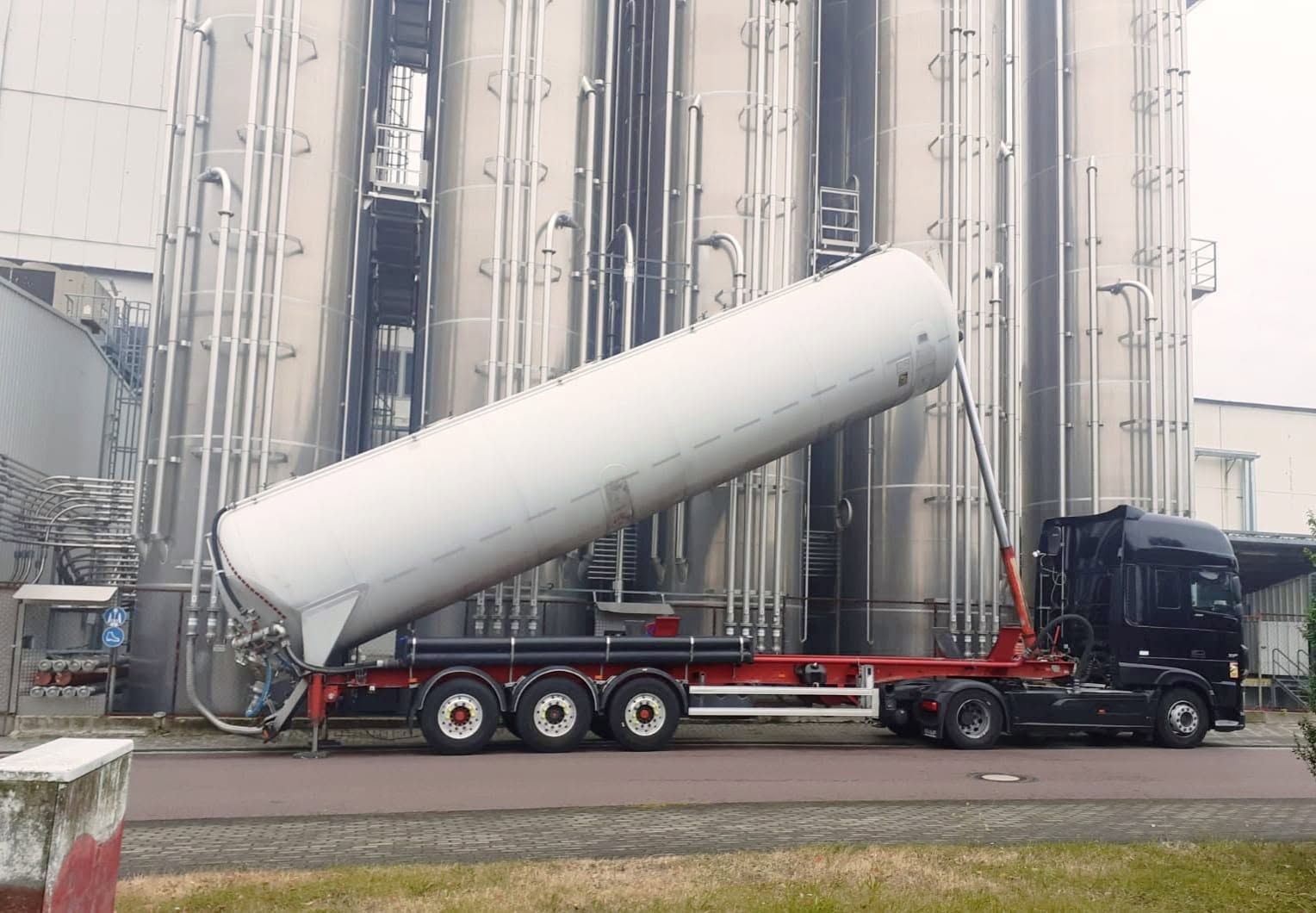
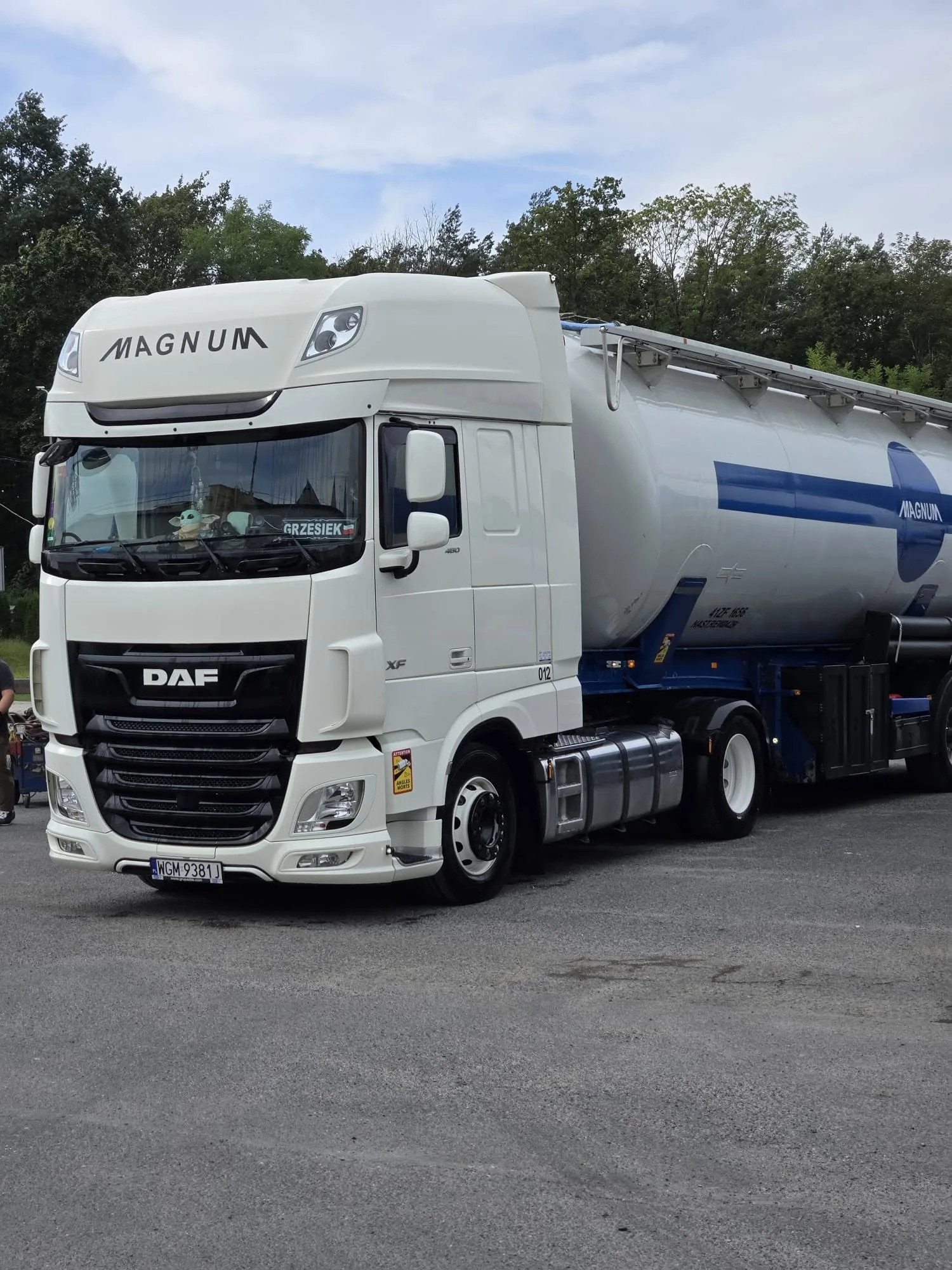
Bulk minerals (lime, chalk, talc, bentonite) are a stable segment of silo trailer transport — low raw material price volatility, regular demand from the chemical and ceramics industries, long contracts. PHS Magnum delivers minerals both to customers in Poland and to DACH consignees.
| Material | Bulk density | Typical payload | Main applications |
|---|---|---|---|
| Hydrated lime | 0.55-1.4 g/cm³ | 24-28 t | Flue gas cleaning, chemicals |
| Ground chalk CaCO₃ | 0.9-1.4 g/cm³ | 25-28 t | Fillers, paper, paints |
| Magnesium talc | 0.3-0.8 g/cm³ | 22-25 t | Cosmetics, rubber, plasticisers |
| Bentonite | 0.8-1.1 g/cm³ | 24-27 t | Foundries, drilling |
| Tonsil 571 FF | 0.55 g/cm³ | 24 t | Bleaching of edible oils |
Hydrated lime Ca(OH)₂
Characteristics and applications
Hydrated (slaked) lime, Ca(OH)₂, is produced by the reaction of quicklime CaO + H₂O. White, slightly alkaline (pH 12.4 in saturated solution). Two main types:
- CL 90-S (>90% Ca(OH)₂, standard) — particle size 90-95% below 90 µm
- CL 80-S (80-89% Ca(OH)₂, lower purity) — similar particle size
Main producers in Poland
- Lhoist Bukowa (Lesser Poland voivodeship)
- Trzuskawica (Świętokrzyskie voivodeship)
- Lhoist Czechia (re-export from the Czech portfolio of the Lhoist Group)
Main applications
- Flue gas cleaning (DeSOx) — coal and biomass power plants inject lime into flue gases to absorb SO₂. The German power industry = a large buyer of Polish lime.
- Acid neutralisation in the chemical industry — fertiliser production, treatment of process wastewater
- Drinking water treatment — municipal waterworks for pH regulation
- Ground stabilisation in construction — subgrade stabilisation for roads and motorways
Transport parameters
- Dryness required — lime reacts with moisture (exothermically), generating flammable dust
- Silo trailer chamber sealed during transport
- Wet chamber washing between loads (especially before polymers)
- Some concentrations can fall into ADR class 8 — requires an ADR-certified silo trailer
Ground chalk (CaCO₃)
Characteristics
Natural or precipitated chalk, finely ground. Particle size 1-10 µm for the most common grades. Very low chemical activity (neutral pH), low abrasiveness (with appropriate grinding).
Main producers in Poland
- Omya Włocławek (part of the Swiss Omya group, the global calcium carbonate leader)
- Calcit Plus (regional)
- Imerys (re-export)
Applications
- Fillers for plastics (PP, PE, PVC) — typically 15-40% by weight, lowers cost and improves dimensional stability
- Paper — filler for alkaline paper pulps
- Paints and coatings — an economical filler
- Animal feed — a calcium source (food-grade)
- Adhesives and sealants — a rheology modifier
Transport parameters
- Relatively neutral — low contamination of subsequent loads
- Slightly abrasive — aeration pads need replacement more often (3-4 years vs 5-6 for polymers)
- Dryness required — chalk cakes at moisture >0.3%
- Food-grade variant — a dedicated certified silo trailer
Magnesium talc (Mg₃Si₄O₁₀(OH)₂)
Characteristics
Hydrated magnesium silicate, a natural mineral. The softest mineral (Mohs hardness 1). Very low bulk density (0.3-0.5 g/cm³ loose), which limits the silo trailer payload to 22-25 tonnes.
Applications
- Cosmetics and pharma — powders, cosmetic talc (after medical purification)
- Rubber industry — filler in tyres, seals
- Plastics — filler in reinforced PP for automotive (dashboards)
- Paper — filler and coating
- Ceramics — a component of ceramic bodies
Main producers
Poland has one mine (the Jelenia Góra Talc Mine near Świeradów). Most talc is imported from Pakistan, India, Brazil — re-exported through Polish wholesalers.
Transport parameters
- Low density = low payload = an economic limitation (the silo trailer rarely reaches the GVW)
- Dusting — requires a tight chamber, wiping down after unloading
- Low chemical activity — neutral contamination
- Cosmetic talc: a silo trailer with a food/medical-grade certificate
Bentonite
Characteristics
A natural montmorillonite clay. Hygroscopic — in the presence of water it swells (up to 10-15× its own volume). It is used precisely because of this property.
Main Polish producers
- Bentonit Strzelin (Lower Silesia voivodeship)
- Bentonit Wapno
- Imports from Italy (Sardinia — IBECO)
Applications
- Foundries — sand mix for moulds (bentonite + sand + coal)
- Drilling (mud) — bentonite fills drilled holes, stabilises the walls
- Absorbents — cat litter, absorbent agents
- Landfill sealing — a natural geomembrane
- Wine and juice clarification — food-grade bentonite
Transport parameters
- Hygroscopic — requires a dry silo trailer and a short transit
- Swells on contact with water — a water incident in the chamber = the load goes for disposal
- Standard dry cleaning between bentonite loads (easy compatibility)
Tonsil 571 FF (bleaching earth)
Characteristics
A specialised blend of bentonite and attapulgite, acid-activated. Used for refinery bleaching of edible oils — palm, sunflower, soybean, coconut.
Producer: Süd-Chemie / Clariant (the most common Tonsil producer in the EU). Other brands: Tonsiil (BASF), Filtrol, B80 (Engelhard).
Applications
- Edible oil refineries in Poland, Germany, the Netherlands (port of Rotterdam)
- Special cosmetic applications — bleaching of waxes, premium fats
Transport parameters
- Low bulk density (0.55 g/cm³) — payload ~24 t in 35-40 m³
- Contamination-sensitive — requires a silo trailer with a dedicated food-grade history
- Wet washing with a food-grade detergent before loading
- Chamber cleanliness certificate on the CMR
Urea (carbamide) CO(NH₂)₂
Characteristics
A solid form of fertiliser nitrogen (46% N). Granulated — beads 1-3 mm in diameter or prills 1-2 mm. Hygroscopic but to a lesser degree than PA/PET.
Applications
- Agricultural fertilisers — direct use or an NPK component
- AdBlue — a 32.5% aqueous solution for SCR systems in Euro 6 vehicles (NOTE: liquid AdBlue = tanker, not silo trailer)
- Plasticisers and adhesives — an industrial component
- Animal feed — a source of non-protein nitrogen
Polish producers
- Grupa Azoty Tarnów (the largest in Poland)
- Grupa Azoty Police
- Anwil Włocławek
Transport parameters
- A dry silo trailer is required — moisture >2% = caking risk
- Slightly hygroscopic — a shorter maximum transit time (<48h at ambient RH >70%)
- Dry cleaning between loads is essential
Other chemical bulk materials
Carbon black
A very light material (density 0.3-0.5 g/cm³). Silo trailer payload: 18-25 tonnes (volume-limited). Applications: tyres, inks, plasticisers. Some dusty particle size grades fall into ADR class 4.1 (flammable solids) — requires an ADR silo trailer.
Coal dust
Finely ground hard or brown coal. Power generation (pulverised solid fuels). Classification depends on the grade (pure dust vs blends). Flammable dust = ADR class 4.1.
Logistics — typical scenarios
Scenario 1: Lime from Bukowa to a power plant in Germany
- Loading: Lhoist Bukowa mine (Lesser Poland voivodeship)
- Distance to Chorula: 250 km (3-4 h)
- Route Chorula → Brandenburg (power plant in Schwarzheide): 6-7 h
- Total: 12-15 h from the mine to the power plant’s silo
- Volume: 1 silo trailer, 25 t per delivery, 3-5 deliveries per week
Scenario 2: Omya chalk to a paper mill in Czechia
- Loading: Omya Włocławek
- Distance Włocławek → Chorula: 350 km (4-5 h)
- Route Chorula → Ostrava (CZ): 3-4 h
- Total: 7-9 h
- Volume: regular 50-80 t/week
Scenario 3: Tonsil 571 FF to an oil refinery in DE
- Loading: Clariant distributor in Poland (Wrocław)
- Route Wrocław → Chorula → Hamburg: ~1,100 km, 14-15 h
- Requirement: a food-grade silo trailer with dedicated washing
- Volume: 20-30 t/month (a mid-scale refinery)
Seasonality of the minerals market
Some minerals show clear seasonality:
- Hydrated lime — peak autumn/winter (DeSOx season at power plants + ground stabilisation for road construction in autumn)
- Bentonite — peak spring/summer (drilling season and surface roads)
- Chalk — stable year-round (plastics and paper production without seasonality)
- Talc — stable, a slight Q3 peak (preparation for the cosmetics season)
For regular customers: capacity planning at PHS Magnum 2-3 months in advance accounts for seasonality.
Quality requirements of mineral customers
| Customer | Requirement | PHS Magnum standard |
|---|---|---|
| Power plant (DeSOx) | Dry silo trailer | Dry cleaning + RH check |
| Paper mills | No pigment contamination | A dedicated chalk silo trailer |
| Cosmetics manufacturer | Food/cosmetic-grade | Wet washing + CEFIC certificate |
| Foundries | No moisture | Dry cleaning with a certificate |
| Agriculture (urea) | No caking | Dry chamber, short transit time |
Contact
Mineral transport by silo:
- Dispatcher phone: +48 602 716 551
- E-mail: biuro@magnumchorula.pl
For mineral enquiries, please provide:
- Material (name, producer, particle size, density)
- MSDS and any ADR classification
- Volume and frequency
- Loading and unloading locations
- Quality requirements (food-grade, dryness, documentation)
Individual quote: 2-4 working hours. Standing agreement for volumes >50 t/month.
Related: Silo transport — a guide · What we transport by silo trailer · Tanker vs silo trailer · Routes to DACH · Silo trailer cleaning · ADR in chemical transport · TDT inspections of silo trailers