In short
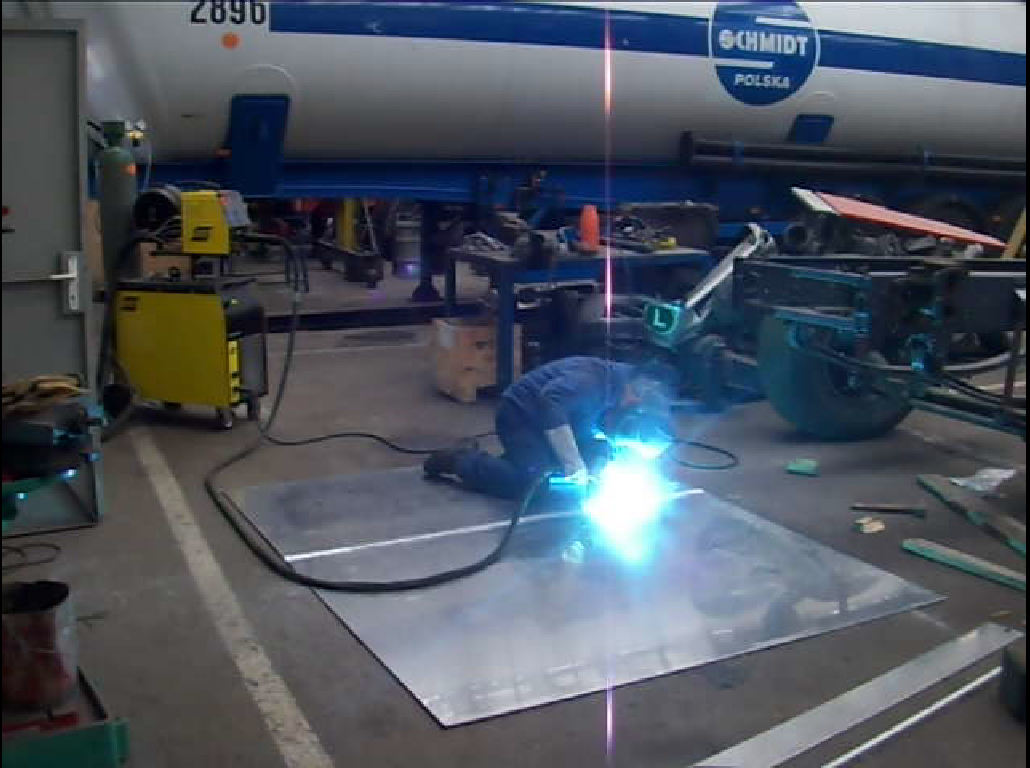
Tipper and half-pipe trailer repair covers welding of steel (S355, Hardox) and aluminium bodies, hydraulic cylinder overhauls, accident repairs of frames, and corrosion protection. PHS Magnum performs the full scope in its hall in Chorula near Opole — 4 km from the A4 — with a crane up to 10 tonnes, MIG/MAG and TIG stations, and its own paint booth.
Types of tippers and half-pipe trailers — what comes into the workshop
Before we get to repairs — a short map of the designs, because each one cracks differently. The discharge method, body cross-section, and plate material determine where stresses accumulate and what wear to expect after a few seasons of work.
Rear-tipping and three-way tippers
Truck tipper bodies (Meiller, Hyva, Tisvol) divide into rear-tipping — the body is lifted by a single telescopic cylinder and discharges to the rear — and three-way, tipping to three sides via corner pivot pins. Three-way bodies have more wear points: pins, sockets, and sidewall hinges on three edges.
The rear-tipping tipper is structurally the simplest and most robust — which is why it dominates in heavy construction and aggregates. Its weak points are the tipping pivot bearings on the rear beam (the whole body mass working on two pins), the front cylinder socket, and the discharge zone at the tailgate, where the floor plate wears fastest. Tipping uphill or on a side slope twists the body relative to the frame and accelerates cracking of the corner welds.
The three-way tipper (one-way in the simplified variant) discharges to the sides and rear — the standard in building materials distribution, municipal work, and agriculture. The price of versatility: a dozen or more pairs of corner pins and sockets that wear unevenly. Play on one pin transfers load to the rest, and the wear sequence accelerates like an avalanche. The typical repair is socket regeneration (weld build-up and reaming to size), pin replacement, and sidewall straightening.
Semi-trailer tippers and half-pipe trailers
Tipper semi-trailers (Wielton, Feber, Fliegl, Schmitz, Kassbohrer) come as classic box bodies and as half-pipes with a semicircular cross-section. A half-pipe has no sharp floor corners, so the load slides out more easily, but all the stress works on the wall-to-floor joint and at the front posts — and that is exactly where cracks appear. We describe the typical cases in the article half-pipe trailer repair — cracks .
The box trailer has a rectangular cross-section, a flat floor, and vertical sidewalls stiffened with posts. Its advantage is high volume and easy excavator loading; its drawback — the floor corners, where the load lingers and stresses concentrate. Cracks start in the lower corners, at the posts, and around the cross reinforcements. A structural steel box is heavier than a Hardox half-pipe of comparable durability, which is why the market keeps shifting towards half-pipes.
The half-pipe trailer is today’s standard for stone, scrap, and demolition work. The semicircular floor, formed from one or two sheets of wear-resistant plate, has no longitudinal welds in the zone of greatest abrasion — its main durability advantage. In return, the sidewall-to-floor joint, the front posts, and the rear tailgate frame carry all the bending stresses during tipping. A half-pipe copes badly with discharge on uneven ground: chassis twist transfers into the thin-walled shell.
Agricultural trailers and construction rigs
The workshop also sees agricultural tipping trailers (Pronar, Metal-Fach, Zasław, Wielton Agro) — structurally simpler, but operated in tough conditions: harvest-season overloading, corrosion from fertilisers and silage, field tracks. Typical repairs are cracks in the lower frames, floor replacement, regeneration of sidewall hinges and central locking systems. The repair technology is the same as for truck bodies — only the plate thicknesses differ.
Manufacturers — design characteristics
| Manufacturer | Design type | Service characteristics |
|---|---|---|
| Wielton | box and half-pipe trailers, steel/aluminium | popularity = parts availability; typical front post cracks |
| Meiller | three-way and rear-tipping bodies, hooklifts | precise hydraulics; pin socket regeneration |
| Bodex | Hardox steel half-pipes, scrap tippers | massive builds; floor and rear tailgate frame repairs |
| Zasław | tipping trailers and semi-trailers | classic designs; frame corrosion, floor replacements |
| Kempf | steel and aluminium half-pipes | light half-pipe shells; fatigue cracks at the floor-to-wall joint |
| Schmitz Cargobull | steel/aluminium half-pipes, boxes | large base in the DACH market; technical documentation available |
| Feber, Fliegl, Kassbohrer, Langendorf, KH-Kipper | half-pipes and boxes | the full range of typical body and hydraulics repairs — Kässbohrer service |
Body materials: structural steel, Hardox, aluminium
| Body material | Application | Damage character |
|---|---|---|
| S235/S355 steel | universal, soil, rubble | corrosion, weld cracks, dents |
| Hardox 400/450/500 | aggregates, stone, scrap | cracks in the heat-affected zone of old repairs, edge abrasion |
| Aluminium | light aggregates, asphalt, farm produce | fatigue cracks, tears at the sidewalls, galvanic corrosion |
A Hardox body is lighter at the same abrasion resistance — but repairing it requires a different welding technology than ordinary steel, as explained below.
Structural steel S355 — frames and universal bodies
S355 is the basic structural steel of tippers: a 355 MPa yield strength, very good weldability without preheating at typical thicknesses, predictable fatigue behaviour. It is used for frames, subframes, posts, reinforcements, and bodies for lighter duties (soil, sand). Its weakness is abrasion — an S355 floor under crushed aggregate wears several times faster than wear-resistant plate. The cheaper S235 variant appears in older and lighter builds.
Wear-resistant Hardox steels — HB 400, 450, 500, and 500 Tuf
Hardox (SSAB) comprises hardened steels of controlled hardness, measured in Brinell units (HB):
| Grade | Hardness | Typical tipper application |
|---|---|---|
| Hardox 400 | approx. 370–430 HBW | universal floors and sidewalls — a good hardness/toughness compromise |
| Hardox 450 | approx. 425–475 HBW | the most popular in half-pipes: aggregates, stone, demolition |
| Hardox 500 | approx. 470–530 HBW | extreme abrasion: scrap, crushed stone, slag |
| Hardox 500 Tuf | approx. 475–505 HBW | “500” hardness with toughness close to “450” — thin half-pipe shells |
The higher the hardness, the greater the abrasion resistance — but also the greater the sensitivity to cold cracking during welding and the lower the tolerance for impacts at low temperatures. Hardox 500 Tuf combines class-500 abrasion resistance with toughness that allows thinner, lighter shells — which is why new premium half-pipes are mostly built from it. For the workshop this matters: the harder the grade and the thicker the plate, the stricter the preheating regime and heat input control.
Domex / Strenx — high-strength steels
Alongside wear plate, manufacturers use high-yield structural steels — Strenx (formerly Domex in cold-rolled products): grades 650, 700, and above. These are used for frames, posts, and load-bearing profiles — thinner and lighter than S355 at the same load capacity. Weldability is good, but the same rule as with Hardox applies: the material owes its properties to thermomechanical processing, so excessive welding heat locally removes them. Strenx frame repairs are not done “in one thick pass” — only with controlled heat input and a considered pass sequence.
Aluminium — lightness at the price of fatigue
Aluminium bodies (5xxx/6xxx alloys) cut kerb weight by several hundred kilograms to over a tonne — every kilogram saved is a kilogram of payload gained. The price: lower abrasion and impact resistance, fatigue cracking without warning signs, and galvanic corrosion wherever aluminium touches steel without separation. An aluminium body is welded by TIG or MIG with wire matched to the alloy, after careful removal of the oxide layer.
Damage catalogue — where downtime starts
Six scenarios keep recurring in the service hall:
- Body cracks — most often in the corners, at reinforcements, and around the cylinder mountings; they start as a hairline scratch at a weld and grow with every tipping cycle
- Floor wear — abrasive loads wear the plate locally; the wear-through usually starts in the discharge zone at the tailgate
- The hydraulic cylinder — an oil film on the rod, the body sinking after lifting, the tipping mechanism working in jerks
- Frame and subframe — cracks at the cylinder bracket and the tipping pivot bearings, corrosion of closed sections
- Sidewalls and tailgate — bulges from angular aggregate, torn hinges, a tailgate closing askew
- Control hydraulics — a leaking valve block, a worn pump, an aerated system: the body lifts slowly or does not close
The rule is brutally simple: a crack ignored in spring means replacing half the floor in autumn. A scratch in plate working under 25+ tonnes of load does not wait. Below, each scenario separately — symptoms, cause, repair direction.
Body and floor cracks
Symptoms: a hairline scratch along a weld or in the plate, rusty “tears” seeping from the crack, paint flaking along the joint, and at an advanced stage — fine cargo sifting through. Cause: stress concentration in the structural nodes (corners, posts, reinforcements, cylinder mounting) combined with cyclical loading. In half-pipes the cracks sit on the wall-to-floor joint; in boxes — in the lower corners. Repair: drilling out the crack tip, grinding down to sound material, multi-pass welding, and on recurrences — a doubler plate or a rib redistributing the stresses.
Abrasive floor wear
Symptoms: a hollow sound and springing plate when tapped, visible rippling of the floor, local through-wear — first in the discharge zone at the tailgate and under the excavator bucket impact point. Cause: every discharge means tonnes of abrasive material sliding down the floor; the cumulative abrasive mileage runs into tens of thousands of cycles. Repair: for local losses — wear-plate inserts; for large-area wear — rebuilding the floor with Hardox sheets welded through to the load-bearing structure. Ultrasonic plate thickness measurement decides which option makes sense.
Sidewall and plating deformation
Symptoms: plating bulges between posts, bent top profiles, a sidewall that does not close along its full length, cracked post welds. Cause: loading impacts (stone dropped from height), cargo surge under hard braking, excavator bucket strikes. Repair: cold straightening or straightening with controlled heating, replacement of plating sections, re-welding and reinforcing posts. Permanently deformed load-bearing profiles are replaced — straightening a profile that has lost its cross-sectional geometry does not restore its load capacity.
Chassis frame and subframe damage
Symptoms: cracks at the cylinder bracket and tipping pivot bearings, scratches in the lower flanges of the main beams, closed sections corroded through, the body “floating” on the frame. Cause: the subframe transfers all tipping forces through two or three points; play in the tipping pivot bearing multiplies the dynamic loads. Corrosion of closed sections progresses from the inside — it shows late on the outside. Repair: welding with full procedural discipline (this is a load-bearing component), doubler plates welded along their length, replacement of profile sections. After any intervention in the frame — a geometry check. It is worth checking the axles and suspension and the braking system at the same time, because a bent frame eats pads and tyres unevenly.
The hydraulic cylinder — leaks and buckling
Symptoms: an oil film on the rod, dripping under the cylinder, the body sinking after lifting, jerky tipping, and in extreme cases — a visibly bent rod. Cause: worn seals and guides (natural wear), scratches and pitting corrosion of the rod (a damaged chrome layer), buckling from tipping on a slope or with an unevenly distributed load. Repair: an overhaul with seal replacement, or replacement of the complete cylinder — criteria below, in the overhaul section.
The hinge system and tipping pins
Symptoms: metallic knocks when raising and lowering the body, visible play on the pins, ovalised sockets, the body “sitting” askew on the frame. Cause: pins working under full load with insufficient lubrication; dirt and aggregate dust act like grinding paste. Repair: replacing pins and bushes, building up and reaming ovalised sockets to size, restoring grease points. Neglected play in the tipping pivot bearing is a direct route to frame cracks — and the repair cost rises by an order of magnitude.
The rear wall and hydraulic tailgate
Symptoms: a tailgate closing askew or not closing, worn top hinges, cracks in the tailgate frame, faulty locking, and on hydraulic tailgates — leaking opening cylinders. Cause: the tailgate takes cargo impacts at every discharge, and the locking mechanism works in the dirtiest zone of the vehicle. Repair: hinge regeneration, straightening and re-welding the tailgate frame, replacing latches and pins, repairing the opening hydraulics. A leaking tailgate means losing cargo on the road — and that is not just a cost but also the haulier’s liability for an offence.
Corrosion — the silent killer of structures
Symptoms: a flaking coating, pitting rust on the body underside and frame, pockets and closed sections rusted through, “swelling” plates in lap joints. Cause: water, mud, and de-icing agents working from below; coating damage from aggregate; unprotected zones after earlier welding repairs. Repair: blasting, replacing corroded sections, rebuilding the coating system — details in the corrosion protection section. Hardware items (hinges, latches, brackets) are best protected by zinc coating .
Where cracks come from — the mechanics of wear
A tipper works in cycles: impact loading (an excavator dropping stone from height), driving over rough construction terrain, tipping under full load. Every cycle means bending and torsional stresses in the same structural nodes. Add abrasion — aggregate sliding down the floor acts like sandpaper at every discharge.
The effect accumulates over years. The weld cracks first — because a welded joint is always a notch, a stress-concentration point. Then the crack runs into the parent material. That is why an experienced workshop does not ask “where did it crack” but “why did it crack” — and only after that diagnosis picks the repair: the weld alone, a doubler plate, a rib, or redesigning the node.
Welding tippers — steel, Hardox, aluminium
Structural steel — MIG/MAG
S235/S355 steel bodies are welded by MIG/MAG. The key is not the weld itself but diagnosing the cause of the crack: if the node cracked from overloading or vibration, merely welding up the scratch brings a recurrence within weeks. A correct repair means grinding the crack out to sound material (with the crack tip drilled out), multi-pass welding, and — where needed — a doubler plate or reinforcing rib changing the stress distribution.
Hardox — a technology with thermal discipline
Hardox steel owes its hardness to heat treatment — and that hardness is easily destroyed by badly managed welding. The procedural rigours:
- Low-hydrogen consumables — wires/electrodes with controlled hydrogen content; hydrogen in the joint means cold cracks
- Preheating — depending on grade and plate thickness; the goal: slowing the cooling of the heat-affected zone
- Heat input control — limited heat, so the material around the weld is not annealed (softened)
- Cooling without draughts and a pass sequence limiting residual stresses
The heat-affected zone is always softer than the parent Hardox — good technique minimises its width, and thoughtful weld placement keeps it away from the zones of greatest abrasion. The full workshop write-up: welding Hardox tipper bodies .
Preheating — indicative values per grade
The need for and temperature of preheating are decided by the combined thickness of the joint (the sum of the joined plate thicknesses at the node) and the steel grade. Indicative values for low-hydrogen consumables, per the steel manufacturer’s guidelines:
| Grade | Typical body thicknesses | Preheating (indicative) |
|---|---|---|
| S355 | 4–8 mm | not required at typical thicknesses |
| Hardox 400 | 4–8 mm | usually not required; at large combined thicknesses approx. 100 °C |
| Hardox 450 | 4–6 mm (half-pipes) | not required at small combined thicknesses; above the threshold approx. 100–125 °C |
| Hardox 500 / 500 Tuf | 4–6 mm | a lower preheating threshold: approx. 100–175 °C depending on combined thickness |
| Strenx 650/700 | frame profiles | per the grade data sheet; heat input discipline matters more than preheating |
Practical rules: temperature is checked with a thermal crayon or pyrometer about 75 mm from the joint; heating is applied broadly and evenly (a heating torch, not a concentrated flame); the interpass temperature should not exceed about 225 °C for wear-resistant steels — above that limit hardness degradation begins. Extra caution applies in winter: plate below +5 °C always needs at least drying and light warming, because condensation moisture means hydrogen in the joint.
Selecting filler materials
For wear-resistant steels, undermatching consumables are generally used — e.g. G3Si1/G4Si1 wires of class G 42–G 50 per EN ISO 14341. It sounds paradoxical but is deliberate: a more ductile weld copes better with shrinkage stresses and does not cold-crack. The joint face will never reproduce Hardox hardness anyway — abrasion resistance is the plate’s job; the weld’s job is holding the structure together. In difficult joints (repairs where preheating is impossible, steels of unknown history) austenitic type-307 consumables are used — more expensive, but hydrogen-tolerant. Covered electrodes must be basic and dried per the manufacturer’s recommendation — an electrode from a damp packet is a ready-made cold-crack generator.
Heat input and distortion control
Heat input (heat introduced per unit weld length) is a parameter that cuts both ways with hardened steels: too low — a cold-cracking risk from over-fast cooling; too high — annealing and softening of the heat-affected zone plus heavy distortion. In workshop practice, for 4–8 mm plate the target is moderate values (around 1.0–1.5 kJ/mm), running shorter, thinner passes instead of one thick one.
Distortion control during major repairs (floor rebuilds, sidewall plating replacement):
- Back-step and skip welding — short weld segments in a considered sequence, not “end to end”
- Tack welding and rigid clamping of plates before final welding; wedges and braces keeping the plane
- Thermal symmetry — running welds in parallel on both sides of the structure’s axis
- Process pauses to equalise temperature instead of continuously heating one region
Classic post-weld heat treatment (stress-relief annealing) is not applied to hardened steels — a furnace would destroy the hardness of the entire plate. Stress relief is replaced by the right pass sequence and, locally, peening of intermediate passes.
Methods: MIG/MAG, TIG, covered electrode
MAG (135) is the primary method for steel body repairs: productive, stable, with good parameter control. TIG (141) is chosen for aluminium, thin plate, and welds demanding the highest cleanliness — slower, but precise. The covered electrode (111) remains the emergency method — e.g. for mobile repairs where MAG gas shielding will not survive the wind; it requires basic, dried electrodes. Method selection is always a compromise between joint access, welding position, and required quality.
Aluminium — TIG
Aluminium bodies are welded by TIG, after careful oxide removal. Aluminium does not signal fatigue the way steel does — fatigue cracks appear suddenly, so during a repair we check the entire neighbourhood of the damage, not just the visible scratch.
Qualifications: EN ISO 9606 and the spirit of EN 1090
A tipper’s body and frame are a cyclically loaded load-bearing structure — welding repairs should be performed by welders with current EN ISO 9606-1 qualifications (steels) in the method and position matching the actual work, and the technology should be described in a WPS in line with EN 1090 practice for steel structures. Not every workshop repair formally falls under EN 1090, but that standard’s discipline (material traceability, qualified procedures, weld inspection) is the right benchmark for components on which the safety of a 40-tonne rig depends. At PHS Magnum, structural welds are made by welders qualified to EN ISO 9606, within the ISO 9001:2015 quality system.
Welding defects and quality control: VT, PT, MT
The most common defects in repair joints and their sources:
| Defect | Source | Operational consequence |
|---|---|---|
| Cold (hydrogen) cracks | damp consumables, no preheating, fast cooling | the joint cracks hours to days after welding |
| Lack of fusion and penetration | too little heat, poor arc handling | a joint at a fraction of its strength, fails under load |
| Linear undercut | too much current, poor technique | a notch — the initiation site of a fatigue crack |
| Porosity | moisture, oil, a draught in the gas shield | a weakened weld cross-section |
| An oversized softened zone | too much heat input with Hardox | accelerated abrasion and cracking next to the weld |
Post-repair inspection: VT (visual testing, EN ISO 17637) of every weld — geometry, undercut, craters; PT (penetrant testing, EN ISO 3452) in critical zones — detects surface cracks invisible to the eye; MT (magnetic particle testing) where discontinuities just below the surface must be found in ferromagnetic steels. Penetrant testing of the cylinder mounting joint takes a quarter of an hour — a failure of that node under a raised body is a scenario nobody wants to test.
Hydraulic cylinder overhauls
The telescopic tipping cylinder works at 200–280 bar and is the single most common cause of a tipper being immobilised. An overhaul covers: disassembly and washing, rod assessment (straightness, scratches, pitting corrosion), polishing or grinding, replacement of the full set of seals and guides, assembly, and a pressure test.
The economics boundary: a straight rod and a healthy barrel = overhaul; a bent rod or a cracked barrel = replacement. Popular cylinders (Hyva, Meiller) are available within 24–48 hours, so sometimes replacement cuts downtime more than repair. The full criteria and the process: tipper cylinder overhaul . Alongside the cylinder, it is worth checking the pump, the valve block, and the oil — contaminated hydraulic oil kills a freshly overhauled cylinder within one season.
The overhaul step by step
- Removal from the vehicle and stripping — draining the oil, removing the pins, extracting the cylinder; for multi-stage telescopes, separating the successive stages under controlled conditions
- Washing and inspection — assessing each stage: rod straightness (measured on V-blocks), the chrome layer, the barrel bore, threads and glands
- Surface work — polishing the rod for minor scratches; honing the barrel if the bore has scored; deep chrome pitting disqualifies the stage for replacement or re-chroming
- Replacing the full set of seals and guides — always the complete kit (piston seals, gland seals, wipers, guide rings), matched to the diameters and oil type; skimping on individual items ends in a second disassembly
- Assembly and pressure testing — assembly in workshop cleanliness, filling, bleeding, a bench test: static tightness at working pressure, smooth extension, no sinking under load
- Installation in the vehicle and a working test — trial tipping, checking connection tightness, oil level and cleanliness in the tank
Watch for the detail that keeps coming back in complaints about other people’s repairs: new seals in a dirty system live for weeks. If the oil is spent or there is sludge in the tank — an oil change and system cleaning are not optional, they are the precondition for the overhaul making sense.
Accident repairs
A tipper or half-pipe collision is usually a combination of damage: a bent frame, torn cylinder mountings, deformed sidewalls, damaged hydraulic and electrical installations. Repair order matters:
- Measuring the chassis geometry — without restoring geometry, all further work is temporary
- Straightening and welding the frame — with weld inspection in the stress zones
- Rebuilding the mountings of the cylinder, the tipping pivot bearings, the tailgate hinges
- Hydraulics and electrics — pressure tests, a tipping test under load
- Painting the repaired zones and documentation
For claims settled through insurance, we prepare a work-scope summary useful for the loss adjuster. The full scope of accident and structural repairs is described on the tipper and half-pipe trailer service page.
Geometry — why everything starts there
A trailer frame after an impact can look fine and be twisted by a dozen or more millimetres over its length — invisible to the eye, but visible in tyre wear after three months. The geometry measurement covers: axle parallelism relative to the kingpin, frame diagonals, and the plane of the main beams’ top flanges (the subframe and tipping pivot bearings sit on it). Straightening is done with hydraulic rams and controlled heating of the bend zones — never “cold and by force” on high-strength steels, because micro-cracks from straightening surface after six months. After straightening, the bend zones and repair welds undergo penetrant testing.
Insurance documentation
For claim settlement we prepare: an inspection report with photo documentation of the damage before repair, a summary of the work scope and materials used, and a final test report (geometry, a hydraulic pressure test, a tipping test). Complete documentation shortens the discussion with the adjuster and speeds up the payout — and with third-party liability claims it is sometimes the haulier’s only hard evidence. If the vehicle cannot be driven after a collision, we help arrange transport to the hall.
Blasting, painting, and corrosion protection
A tipper corrodes from below: water, mud, and de-icing agents work on the frame, the body underside, and the hinges. After every welding repair, the joint zone has no coating — and that is exactly where corrosion starts fastest.
The correct sequence: blasting to at least Sa 2 (removing rust and old coatings), an epoxy primer on bare metal, and a polyurethane topcoat resistant to abrasion and UV. Post-repair painting is done in our own paint booth — no subcontractors and no extra trailer transport between sites.
Surface preparation — Sa 2½ as the renovation standard
More than half of any coating’s durability depends on substrate preparation. For a full renovation, abrasive blasting to grade Sa 2½ per EN ISO 8501-1 applies: after blasting, the surface is free of mill scale, rust, and old coatings, with only trace shading permitted. Painting “over a wire brush” (St 2/St 3) is a spot solution only — a coating on under-cleaned rust detaches from the substrate in the first frosty season. Process details: trailer sandblasting .
The coating system — epoxy plus polyurethane
A proven system for tippers working in construction:
| Layer | Material | Role |
|---|---|---|
| Primer | zinc-rich epoxy or anticorrosive epoxy | adhesion to the steel, a corrosion barrier |
| Intermediate (for full renovation) | high-build epoxy | building system thickness, sealing |
| Topcoat | polyurethane | resistance to UV, abrasion, and road chemicals; the fleet colour |
The total dry film thickness for tipper working conditions is usually 200–280 µm, measured with a gauge after curing. A system built this way on an Sa 2½ substrate genuinely survives many seasons of mud and salt — while a single coat of “topcoat over rust” does not survive one. The full booth painting process is described on the trailer paint renovation page.
The insides of working bodies are usually not fully painted — aggregate strips any coating within weeks. What gets painted: the body underside, the frame, the sidewalls from the outside, and the tailgate zones; the interior is protected by the wear plate itself.
Repair or replace the body — decision criteria
The most expensive mistake is overhauling a body with no prospects — or replacing one that could have been saved. Base the decision on measurements, not impressions:
| Criterion | Points to repair | Points to replacement/rebuild |
|---|---|---|
| Floor | local abrasion, point losses | plate worn below safe thickness over a large area |
| Cracks | single, in typical nodes | a web of fatigue cracks in many zones |
| Sidewalls | dents that can be straightened | permanent deformation of load-bearing profiles |
| Subframe | healthy, surface corrosion | corroded closed sections, cracks |
| Repair history | first or second repair | repeated patching of the same spots |
The intermediate solution, often the most economical: rebuilding the floor with Hardox plate and reinforcing the corners, while keeping the sidewalls and frame. The body gains abrasion resistance better than factory structural steel, at a fraction of the cost of a new body. We give the final recommendation after plate thickness measurements and an inspection in the hall — the PHS Magnum tipper service quotes the scope with no obligation.
Two extra variables worth adding to the calculation. Fleet age and plan: rebuilding the floor of a trailer that will run for 5+ more years pays back many times over; the same work on a vehicle due for sale in a year — not necessarily, although a documented repair raises resale value. Availability of a replacement vehicle: if the fleet has no reserve, time counts as much as scope — replacing the complete cylinder, or staging the repair (first what immobilises the vehicle, the rest in winter), can beat a perfect overhaul in mid-season.
Non-destructive testing and periodic structural inspections
Non-destructive testing (NDT) in tipper service is not exotic — it is a cheap way to catch a crack before it becomes a failure. When it makes sense:
- After every load-bearing component repair — penetrant testing (PT) per EN ISO 3452 of the cylinder mounting welds, the tipping pivot bearings, and frame nodes
- After frame straightening — the bend and heating zones checked for micro-cracks
- When buying a used trailer — an hour of testing the critical zones says more about the vehicle than the paint; fresh paint on the welds is the classic way of masking cracks
- Periodically on structures with a repair history — nodes patched repeatedly are worth checking every season
- Ultrasonic plate thickness measurement — the only objective basis for the repair-vs-floor-rebuild decision; a thickness map shows the real material reserve
To complete the picture: tippers and half-pipe trailers are not subject to TDT supervision the way silo trailer pressure vessels are — no authority will inspect the body and frame structure ex officio. Responsibility for the technical condition of the load-bearing structure rests entirely with the haulier, and the only control mechanism is the service inspection. That is an argument for having someone who knows where to look go over the structure once a year.
Prevention — how to extend the body’s service life
Most major tipper repairs start with a small item that could have been caught during a routine check. A simple inspection every 4–6 weeks of intensive operation:
- Corner welds and the cylinder mounting — look for hairline scratches, rusty “tears” seeping from a crack, paint flaking along a weld
- The cylinder rod — an oil film, scratches, spots of pitting; a body sinking after lifting signals worn seals
- The body floor — tap the discharge zones; a hollow sound and springing plate betray under-side wear invisible to the eye
- The tailgate and hinges — play, skewed closing, worn pins
- The hydraulic oil — level and colour; a milky tint means water in the system
Operating habits that genuinely extend body life
- Tipping only on level, firm ground — discharging on a side slope is the single biggest killer of cylinders (buckling) and body welds (twisting)
- Loading from the centre of the body, not from the sidewall — the first buckets onto the middle of the floor cushion the next ones; dropping stone from height into an empty body at the sidewall means dents and micro-cracks
- Greasing the tipping pins and hinges on schedule — a pin running dry under load ovalises its sockets within one season
- Washing the chassis after work in salt and mud — especially the frame pockets and tailgate zones; corrosion feeds on lingering mud
- Reacting to the first knock — play audible during tipping is cheap to fix; play ignored transfers to the frame
- A winter structural inspection — once a year, off-season, a full check of the welds and a floor thickness measurement
Seasonality matters: construction works from spring to late autumn, so winter is the natural window for planned repairs — welding, floor rebuilds, cylinder overhauls, and painting. A repair planned for winter does not take the vehicle out of work; a breakdown in June does, and at the worst moment — when every day of downtime means missed runs and the risk of contractual penalties from the general contractor.
How to commission a repair — step by step
- Call or write — +48 602 716 551 / biuro@magnumchorula.pl : vehicle type, body brand, a description of the symptoms, photos of the damage
- Diagnostics in the hall — structural inspection, plate thickness measurement, a hydraulic tightness test; we set the scope and a quote with no obligation
- Repair — welding, cylinder overhaul or replacement, frame straightening, sidewall replacement, or floor rebuild
- Protection and inspection — blasting, painting, a tipping test under load
- Handover with documentation — a service report; for road accident claims, a summary for the settlement
Why repair at a trailer specialist
A tipper is a welded structure working cyclically under full load — quick fixes by a random welder come back. PHS Magnum services specialist trailers daily, since 1991, with ISO 9001:2015 certification:
- The hall in Chorula near Opole — 4 km from the A4 Gogolin junction, about 180 km from the German border; convenient access for rigs from the region and from abroad
- A crane up to 10 tonnes, MIG/MAG and TIG stations, a paint booth — the entire repair under one roof
- Welders qualified to EN ISO 9606, VT/PT weld inspection — technology, not improvisation
- Brands: Wielton, Feber, Schmitz Cargobull, Meiller, Hyva (Hyva service ), Kassbohrer, Fliegl, Tisvol
- Mobile service for minor hydraulic failures — a radius of about 100 km
- A mixed fleet? Silo trailers, tankers, and tippers in one fleet are covered by the PHS Magnum service network — including spitzer.pl trailer service for silo trailers; how to organise servicing of different trailer types with one partner is covered in our article on mixed fleet service
The workshop’s complete service range — from brakes and EBS to sandblasting — is on the trailer and truck service page.
Contact — repair quote
Describe the fault by phone or email: vehicle type, body brand, symptoms. We prepare the quote from the description or after an inspection — with no obligation.
Service / repairs: +48 602 716 551 biuro@magnumchorula.pl
Mon–Fri 06:00–20:00 · Sat 07:00–15:00
Related: Tipper and half-pipe trailer service · Welding Hardox bodies · Tipper cylinder overhaul · Half-pipe trailer repair · Trailer sandblasting · Paint renovation