In brief
Storz is the standard coupling on European silo trailers — a symmetrical quick coupling, simple to operate. PERROT ɸM 108 (4") is a threaded coupling, found at consignees with agricultural-industrial infrastructure. Most silo trailers have Storz; when the consignee requires PERROT, the simplest solution is an adapter hose left permanently at the consignee — without re-equipping the trailer for every delivery.
Why the coupling type matters at all
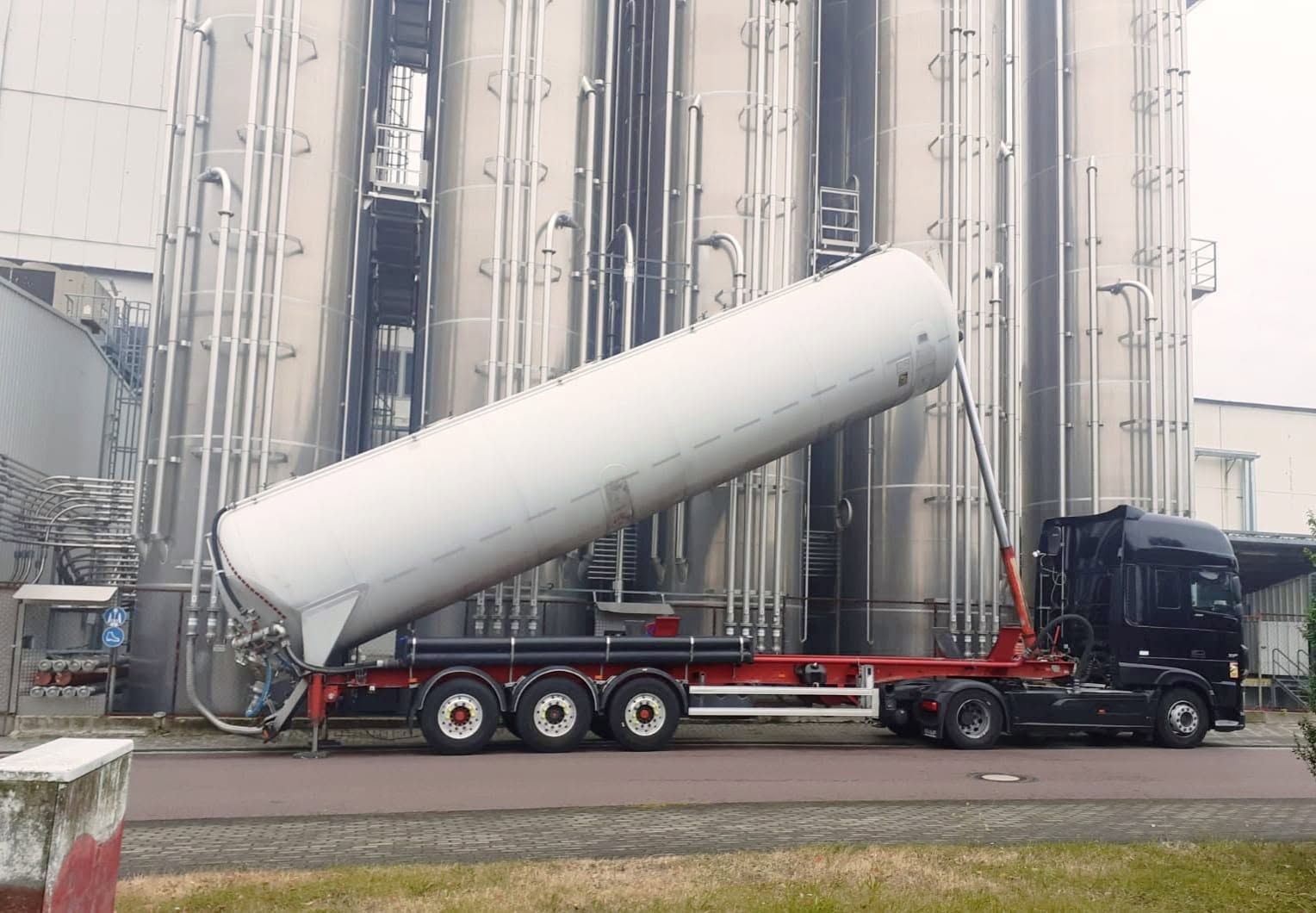
When transporting PE/PP granulates, lime, talc and other bulk materials by silo trailer — the key moment is connecting the trailer to the consignee’s installation. If the coupling does not fit, the delivery stands still. Several hours of driver time plus silo trailer downtime add up to a cost measured in thousands per day — regardless of who is formally responsible for the incompatibility.
In the archive of our enquiries this topic returns regularly. Customers ask about couplings in advance, because they have already experienced situations where a delivery could not be unloaded. Recording this knowledge in one place — in the form of the guide below — is also a contribution to standardising the market.
Comparison table: Storz vs PERROT
| Feature | Storz | PERROT ɸM 108 |
|---|---|---|
| Coupling type | Symmetrical quick coupling (claw coupling) | Threaded (nut) |
| Connection time | Seconds — a 60° turn | Minutes — threading the nut |
| Symmetry | Both ends identical | Male + female (separate ends) |
| Typical diameters | ɸM 75 (3"), ɸM 100 (4") | ɸM 108 (4"), less often ɸM 110, ɸM 125 |
| Sealing reliability | High, proven for most deliveries | Very high, better at high pressure |
| Standard on silo trailers | Yes, dominant in the EU | Less common |
| Standard in agriculture | Rarer | Yes, dominant |
| Adapters available | Storz → PERROT, Storz → Camlock | PERROT → Storz, PERROT → flange |
| Cleaning frequency | Medium | Higher (the thread collects dust) |
When the consignee requires PERROT — and what to do then
The three most frequent scenarios in which a consignee has PERROT infrastructure:
1. Plants with an agricultural or industrial history
Feed producers, fertiliser blending plants, some lime works — in these industries PERROT was the standard for decades. Converting to Storz is an investment many consignees keep postponing — because PERROT simply works.
2. Cement plants and concrete prefabricators
Some Polish and Czech cement plants maintain PERROT infrastructure for materials of higher bulk density. PERROT copes better with higher unloading pressure.
3. Foreign consignees with local specifics
In DACH and some BENELUX countries we encounter consignees who prefer PERROT for technical materials. The reason: tightness and resistance to leaky deliveries.
The “adapter hose left at the consignee” model
This is the most practical solution developed in our practice for regular deliveries to PERROT consignees:
- Once, we prepare a discharge hose terminated with a PERROT ɸM 108 coupling on one side and the appropriate adapter for our trailer on the other.
- We physically leave it at the consignee — the hose stays in their installation.
- On every subsequent delivery the driver connects to the hose sitting at the customer — no adapter transport, no coupling swaps.
- Maintenance on the consignee’s side — the hose is used only with our deliveries, but is serviced by the plant’s staff as standard.
The cost of a one-off PERROT hose is a fraction of the cost of one day of trailer downtime. At 10+ deliveries a year, the investment pays back immediately.
What to arrange before the first delivery
Questions to agree with the consignee before sending the first silo trailer:
- Coupling type: Storz or PERROT? (if PERROT — the diameter)
- Required diameter (typically 3" or 4")
- Hose length: is 5 m enough? Or is 10 m needed (the distance between the ramp and the silo)?
- Working pressure of the installation: typically 1–2 bar for granulates, up to 2.5 bar for materials of higher bulk density
- Does the consignee have their own compressor? If not — the trailer must have an on-board compressor
PHS Magnum verifies these parameters as standard in the technical questionnaire sent with the first quote. For regular customers we remember their specifics and do not ask again with subsequent orders.
Replacing the coupling on the trailer — when it makes sense
Sometimes it is worth investing in a permanent replacement of the discharge fittings on the trailer rather than using an adapter hose. Situations:
- The trailer has one main consignee with PERROT infrastructure (90% of deliveries go there)
- The customer has a required PERROT specification in the product certification (e.g. feed)
- The old adapter hose has worn out and re-equipping the trailer gives a better ROI
Replacing a silo trailer’s fittings is typically a 1–2 day workshop job. PHS Magnum in Chorula has complete facilities for such modifications — with the documentation required for TDT examinations issued.
Summary — what to choose
| Your situation | Recommendation |
|---|---|
| A single delivery to a PERROT consignee | An adapter hose for the single delivery, returned with the trailer |
| 5+ deliveries per year to the same PERROT consignee | An adapter hose left at the consignee — the best ROI |
| All deliveries go to PERROT infrastructure | Consider replacing the trailer’s fittings with PERROT |
| Mixed Storz/PERROT deliveries | Stay with Storz on the trailer + separate adapter hoses |
Couplings are a technical detail, but they decide whether a delivery finishes at 14:00 or at 18:00. Standardisation at the level of a long-term contract saves dozens of driver hours per year.
Technical questions about couplings or silo trailer service: +48 602 716 551 (PHS Magnum Chorula service workshop).
Transport and transloading orders: +48 664 135 005 (SMIALA terminal — big-bag transloading).
Related: Silo trailer service and repair · TDT technical supervision · Spare parts · Bulk material transport · Big-bag transloading · Discharge coupling replacement — PERROT and Storz workshop service