Key takeaways
ADR (the European agreement on the carriage of dangerous goods by road) governs the transport of substances classified as dangerous — toxic, flammable, corrosive and so on. Most of the materials PHS Magnum carries do NOT fall under ADR (standard polymer granules), but for selected classes (4.1, 8, 9) we have dedicated competence.
| Parameter | Value |
|---|---|
| ADR classes handled | 4.1, 8, 9 |
| Classes NOT handled | 1, 2, 3, 5, 6, 7 |
| Driver certificate | ADR basic + tank course |
| Vehicle certificate | TDT with ADR approval |
| Emergency procedure | ADR written instructions |
| Standard | ISO 9001:2015 |
What is ADR
ADR (French: Accord européen relatif au transport international des marchandises Dangereuses par Route) is a European agreement signed by 53 states governing the road transport of dangerous goods. In Poland it is implemented by statute and updated every 2 years (latest version: ADR 2025).
ADR defines:
- Material classification — 9 main classes (+ subclasses)
- Vehicle design requirements — tanks, seals, markings
- Documentation requirements — transport document, written instructions, certificates
- Driver requirements — ADR training, periodic medical examinations
- Emergency procedures — what to do in the event of an accident, spill or fire
- Routes — bans/restrictions in tunnels, cities, on bridges
The 9 ADR classes — quick overview
Class 1 — Explosives
Ammunition, pyrotechnics. PHS Magnum does NOT handle — requires specialist carriers with military licences.
Class 2 — Gases
Oxygen, LPG, LNG, propane, butane, chlorine, ammonia. PHS Magnum does NOT handle — requires specialist pressure tankers.
Class 3 — Flammable liquids
Petrol, diesel, ethanol, solvents, lubricating oils. PHS Magnum does NOT handle — requires certified fuel tankers.
Class 4 — Flammable / self-igniting solids
4.1 — flammable solids (sulphur, certain reactive polymers, some types of carbon black)
4.2 — spontaneously combustible substances (yellow phosphorus)
4.3 — substances emitting flammable gas in contact with water (powdered metallic zinc)
PHS Magnum handles class 4.1 for selected materials (technical carbon black in certain forms, sulphur granulate for fertilisers). We do NOT handle 4.2 or 4.3.
Class 5 — Oxidisers
5.1 — oxidising agents (hydrogen peroxide, nitrites, chlorates)
5.2 — organic peroxides (highly reactive)
PHS Magnum does NOT handle — requires dedicated equipment and procedures.
Class 6 — Toxic and infectious
6.1 — toxic substances (arsenic, cyanides, pesticides)
6.2 — infectious substances (medical samples, hospital waste)
PHS Magnum does NOT handle 6.1 groups I-II (highly toxic). Class 6.2 requires specialist medical transport.
Class 7 — Radioactive materials
Isotopes, radioactive materials. PHS Magnum does NOT handle — requires licences and specialist shielded equipment.
Class 8 — Corrosives
Acids (sulphuric, phosphoric), strong bases (NaOH, KOH), hydrated lime in some forms. PHS Magnum handles selected class 8 materials — mainly dry hydrated lime for the chemical industry.
Class 9 — Miscellaneous (not classified elsewhere)
Environmentally hazardous materials, lithium batteries, hot liquids, dry ice, some granules with additives. PHS Magnum handles selected class 9 materials — e.g. certain regranulates with special additives.
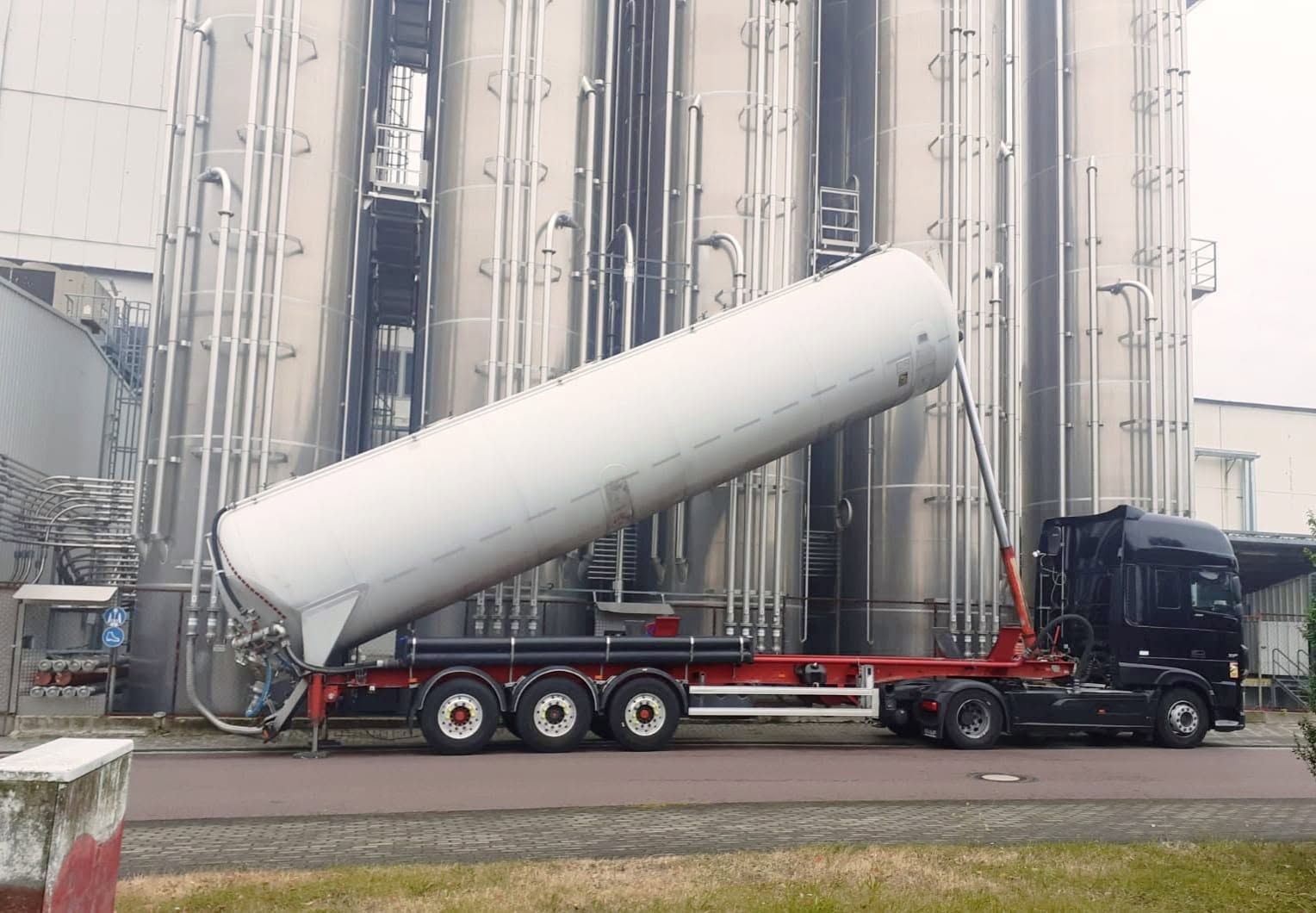
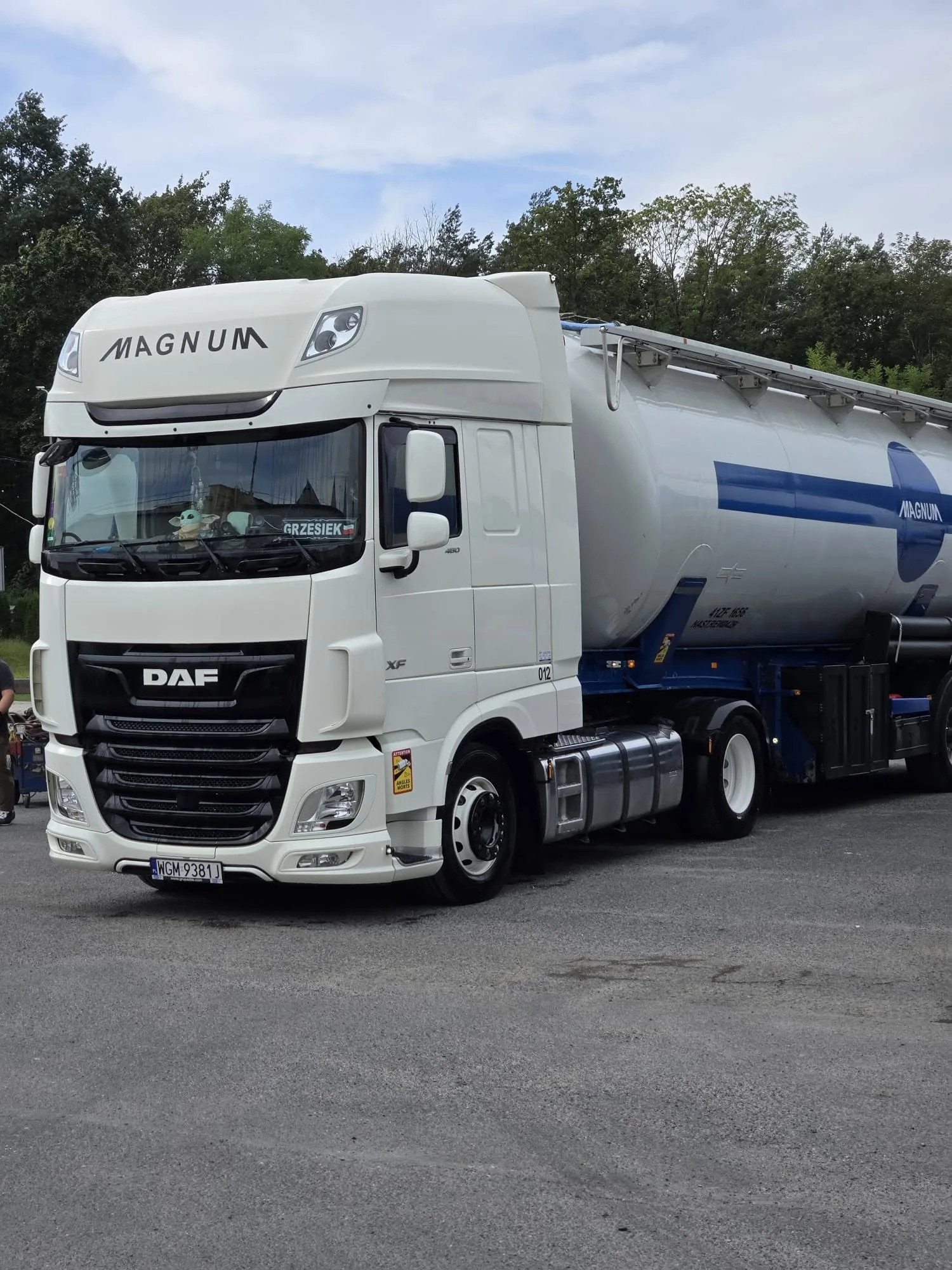
Requirements for an ADR silo trailer
Vehicle design
- Tank with ADR certificate (designation X, Y or Z depending on class)
- Safety valves approved for the given class
- TDT seals on manholes — tamper-proof, checked at every inspection
- External marking:
- Orange plates with the Kemler hazard code (4 upper digits) and the UN number (4 lower digits)
- Class labels (diamond-shaped, coloured according to class)
- Some classes: additional background marking
- Emergency equipment: fire extinguisher (specification depends on class), absorbent bags, shovel, fire blanket
- ADR vehicle approval certificate — issued by TDT, valid for 1 year
TDT certificate with ADR approval
A standard TDT inspection of a silo trailer covers strength and tightness checks. For ADR, additional validation is required:
- Increased pressure test (typically 1.3× MOP)
- Internal inspection with PT testing of circumferential welds
- Safety valve check with calibration documentation
- ADR approval certificate valid for 1 year (vs 2-5 years for a standard TDT inspection)
ADR driver qualifications
ADR training certificate
Courses run by authorised centres (in Poland ~50 centres). Structure:
- ADR basic course (18h) — allows carrying ADR packages in vehicles < 7.5 t
- ADR tank course (12h) — required for tankers/silo trailers
- Specialist course (classes 1, 7) — for explosives and radioactive materials
The certificate is valid for 5 years — after that a refresher course is required (8-16h depending on type).
ADR health record book
Medical examinations every 5 years (from age 55 every 3 years, from 65 — annually). Checks on vision, hearing, memory and reaction times.
Certificate of professional competence
For professional drivers — the standard certificate plus the ADR endorsement. All must be current.
Roadside ADR checks
Some regions (including Opole voivodeship) run periodic roadside checks focused on ADR. The driver may be asked about:
- Cargo classes
- UN code
- Emergency procedures (written instructions)
- Permitted tunnel category
Inability to answer = the vehicle is detained for clarification.
Documents on board
ADR transport document
Normally on the CMR plus an additional ADR element. It contains:
- UN number (e.g. UN 1428 — sodium)
- Full material name (Proper Shipping Name)
- Class, packing group
- Number and type of packages (for tanks: “tank”)
- Net mass
- Name and address of consignor and consignee
- Declaration: “The goods listed above are packed, labelled and declared in accordance with ADR”
Written instructions (ADR)
A 4-page document in the languages of the driver and of every transit country. It contains:
- Driver actions in the event of an accident
- Class-specific procedures (e.g. sodium hydroxide spill)
- Internal emergency numbers (PHS Magnum dispatcher)
- Required protective equipment
Vehicle approval certificate
Issued by TDT, A4 format, with a photograph of the vehicle. It lists the classes permitted for carriage, maximum load and restrictions (e.g. aluminium tank only).
MSDS of the material
Safety data sheet (REACH Regulation 2006/1907/EC). Sections 1-16: identification, hazards, waste handling, transport.
ADR routes and restrictions
Tunnels
ADR divides road tunnels into 5 categories (A-E) by risk. Certain materials are banned in categories B-E:
- A — all materials permitted
- B — ban on class 1 explosives
- C — ban on explosives (1) + oxidisers (5)
- D — ban on 1, 5, 4 + some class 8
- E — ban on all classes except ADR-EX materials (a special low-hazard category)
Route planning across the EU takes the tunnel category into account. PHS Magnum uses truck GPS tools with an ADR tunnel database.
Time restrictions
Some countries (Austria, Italy, Switzerland) ban ADR transport:
- At weekends (Saturday-Sunday)
- On public holidays
- At night (22:00-06:00) on certain sections
Geographic restrictions
- Switzerland: only certain ADR routes permitted (the “road”/“rail” procedure — some materials by rail only)
- Czechia: bridge restrictions on the D11
- Germany: toll-road bans for some class 4.1 and 5.1 materials at specified times
Procedures in the event of an accident
Step 1: Securing the scene
- Stop the vehicle in a safe place (out of traffic, on the hard shoulder if possible)
- Switch on the hazard lights
- Put on a high-visibility vest
- Set up warning triangles (50 m, 100 m, 150 m)
Step 2: Calling for help
Call 112 with the following information:
- “Accident involving an ADR vehicle”
- UN number of the material (from the transport document)
- ADR class
- Precise location (GPS, road kilometre)
- Condition of the driver
Plus the PHS Magnum dispatcher: +48 602 716 551 — assistance coordination.
Step 3: Actions according to class
The ADR written instructions contain detailed procedures for each class. Examples:
- Class 4.1 (flammable carbon black) — protect from ignition, move away from the vehicle, extinguish with ABC powder
- Class 8 (dry lime) — neutralise spilled material with clean sand or salt, protect from contact with water (alkalinity increases)
- Class 9 (regranulates with additives) — depending on the specifics, usually secure the material and notify the manufacturer
Step 4: Report
Within 24 hours, a written report to:
- The employer (PHS Magnum)
- The insurer
- The road transport inspectorate (if requested)
- The material manufacturer (in the event of a spill/contamination)
What PHS Magnum can (and cannot) carry
YES — we handle ADR for:
- Technical carbon black class 4.1 (certain types) — tyre industry
- Dry hydrated lime class 8 (powder form) — chemical industry
- Selected regranulates with additives class 9 — certified recyclers
- Flammable coal dust class 4.1 — power industry
NO — we do not handle ADR for:
- Classes 1 (explosives), 2 (gases), 3 (fuels), 5 (oxidisers), 6 groups I-II (highly toxic), 7 (radioactive)
- Liquid ADR materials (a tanker is needed, not a silo trailer)
- Packaged materials (less than a full load) — LTL ADR partners
For unsupported classes — we recommend industry partners. We can act as an intermediary.
Contact
Silo transport with ADR:
- Dispatcher phone: +48 602 716 551
- E-mail: biuro@magnumchorula.pl
For ADR enquiries, please provide:
- UN number + material name
- MSDS safety data sheet
- REACH compliance certificate
- Volume, loading/unloading location, timeframe
Initial compatibility assessment: 2-4 working hours.
Related: Silo transport — a guide · What we carry by silo trailer · Routes to DACH · Silo trailer cleaning · TDT inspections of silo trailers