At a glance
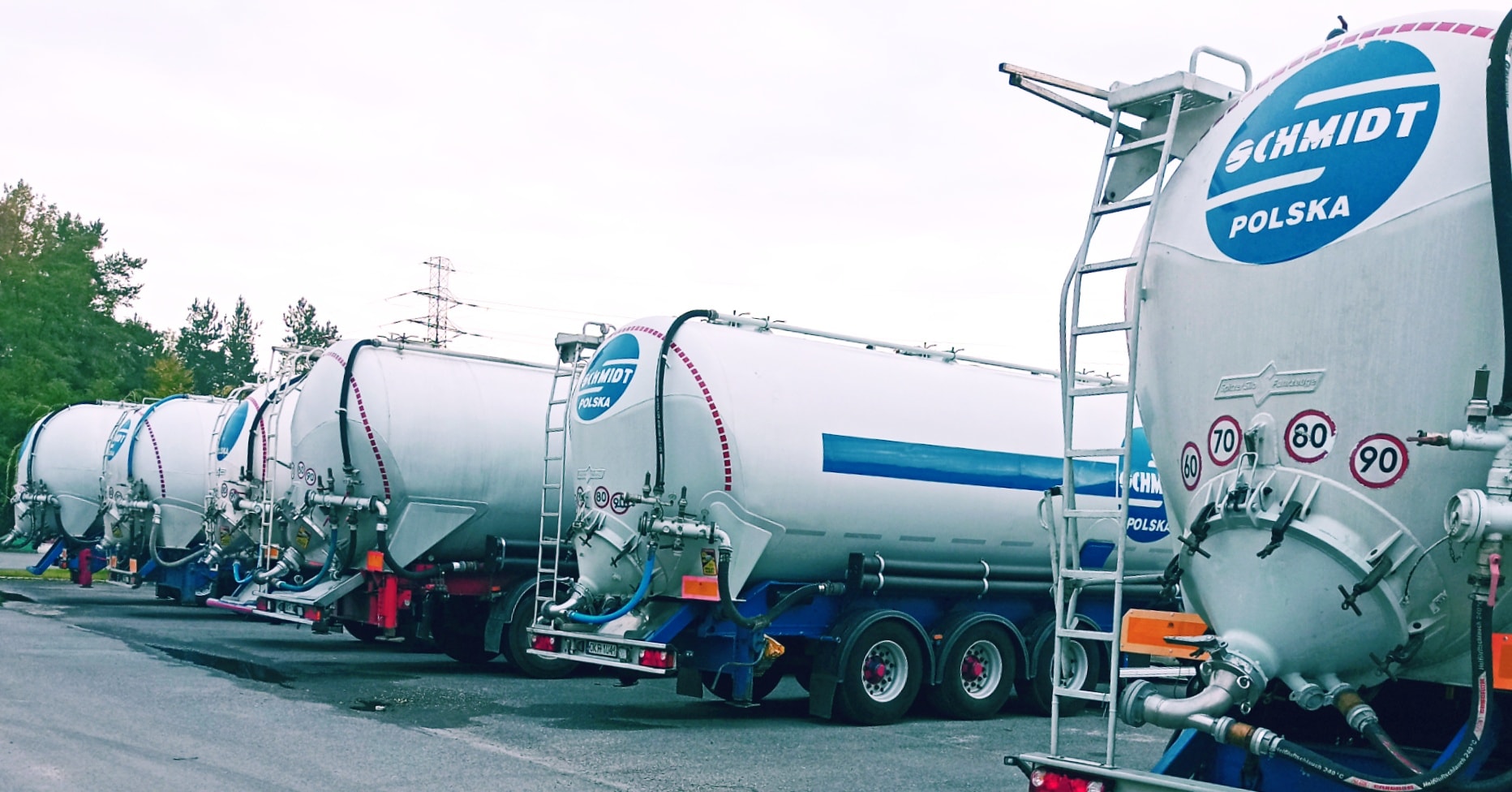
Bulk mineral transport — hydrated lime, quicklime (ADR class 8), talc, bentonite, Tonsil 571 FF, ashes, urea — by 55–65 m³ silo trailers. A dedicated mineral fleet (separate from food-grade), reinforced components for abrasion. Routes across Poland and the entire EU, ISO 9001:2015, base 4 km from the A4 (Gogolin junction).
How to order mineral transport — step by step
From enquiry to unloading (with ADR handling for quicklime):
- Enquiry — material (hydrated lime/quicklime, talc, bentonite, Tonsil, urea), ADR or not, tonnage, route. Tel: +48 602 716 551.
- Trailer selection and quote — mineral silo trailer (reinforced pads and filters) or ADR-certified for quicklime (class 8, UN 1910).
- Loading — pneumatic or via transloading from big bags; dryness check for hygroscopic materials.
- Carriage — routes across Poland and the entire EU; for ADR, verification of UN approval on the route.
- Unloading and documents — pneumatic unloading, CMR; for ADR a full set of transport documents.
Bulk minerals — a niche specialisation
Bulk mineral transport is PHS Magnum’s second main segment alongside plastic granulates. Its characteristics: higher material abrasion, shorter silo trailer component life, more frequent service interventions.
PHS Magnum: a dedicated mineral fleet (separate from the food-grade granulate fleet), cleaning procedures between categories, material certificates.
Material categories
Hydrated lime (Ca(OH)2)
Main segment: construction sector (mortars, aerated concrete), environmental sector (wastewater treatment plants, biogas plants — acid neutralisation).
- Density: 0.5 g/cm³ — a 55–65 m³ silo trailer = ~30 tonnes (GVW limit)
- Not ADR
- Requires a clean silo trailer (no plastic granulate residue — wrong pH environment)
- Abrasion: high (Mohs hardness 2-3, fine grains)
Main producers in Poland: Lhoist Bukowa, Lafarge Strzelce Opolskie, Górażdże cement plant.
Quicklime (CaO) — ADR Class 8
Specialist segment: chemical, metallurgical and environmental sectors.
- ADR Class 8 (corrosive substance), UN 1910
- Requires a silo trailer certified for ADR Class 8
- Driver with ADR Class 8 qualifications
- Reactive with water (exothermic reaction → hydrated lime + heat)
- Requires an absolutely dry silo trailer
PHS Magnum: part of the fleet holds ADR qualifications.
Talc (magnesium silicate)
Segment for: cosmetics, rubber, paper and pharmaceutical industries.
- Density: 0.6-0.7 g/cm³
- Not ADR
- Food-grade and industrial — different purity classes
- Very fine grains (≤10 µm in some classes) — requires dense dust filters
Food-grade talc — requires a dedicated food-grade silo trailer, like PET granulate.
Bentonite
Segment for: drilling (drilling muds), foundry (moulding), cosmetics, environmental (landfill compaction).
- Density: 1.0-1.1 g/cm³ — full use of a 55–65 m³ silo trailer’s GVW (27 tonnes)
- Not ADR
- Expansive clay — absorbs water (up to 10x its own weight) → requires absolutely dry transport
- Contamination: tolerance for small residues of other materials is higher than for granulates
Tonsil 571 FF (sorbent)
Segment for: chemical industry (oil purification), food industry (fat filtration), printing.
- Activated clay (montmorillonite)
- Density: ~0.7 g/cm³
- Not ADR
- Special Tonsil 571 FF class — a sorbent for the oil industry (bleaching of edible oils)
Fly ash
Segment for: construction sector (clinker substitutes in cements, aerated concrete).
- Density: 0.7-1.1 g/cm³ (various classes)
- Usually not ADR (specific classes may require it)
- A material from coal combustion processes — various specifications (Class A, B, C depending on oxide content)
Granulated urea
Segment for: agriculture (fertilisers), automotive (AdBlue/SCR).
- Density: 0.7-0.8 g/cm³
- Not ADR (pure urea)
- Hygroscopic — dry transport required
The specifics of silo trailers for minerals
Mineral materials are more abrasive than plastic granulates — this requires:
Reinforced aeration pads
- PTFE — the most abrasion-resistant
- Reinforced HDPE polyethylene (industrial classes)
- Replacement every 18-24 months (vs 24-36 months for plastic granulates)
Reinforced gaskets
- Industrial EPDM (not food-grade)
- Higher Shore A hardness
- Replacement every 18-24 months
Dust filters
- Hydrated lime, talc — very fine dusts
- Requirement of ≤10 µm filters for the air dryer
- More frequent filter replacement (every 3-6 months)
Cleaning procedure after a cycle
- Lime → drying + blow-through with dry air (NOTE: reaction with water = exotherm)
- Talc → blow-through + residue check
- Bentonite → 48h drying before the next cycle (water absorbency)
Most frequent routes
Within Poland
- Lhoist Bukowa → Górażdże, Ożarów cement plants: 200-300 km
- Górażdże cement plant → consignees in Małopolska/Silesia: 100-250 km
- Recyclers → construction material producers: 200-500 km
International
- PL → Bavaria (DE) for construction lime: 600-900 km, 9-12h
- PL → Saxony (DE) for fly ash: 400-600 km, 5-8h
- PL → Austria (Linz, Vienna) for bentonite: 700-900 km, 10-12h