At a glance
Carbon black transport in dedicated silo trailers — a separate fleet on account of the material’s colour and fine particles. ASTM grades N100–N900 for the tyre, rubber and printing industries. Reinforced dust filters, safety procedures. Routes across Poland and the entire EU, ISO 9001:2015, base 4 km from the A4 (Gogolin junction).
How to order carbon black transport — step by step
From enquiry to discharge with a carbon-black-dedicated silo trailer:
- Enquiry — ASTM grade (N100–N900), tonnage, route and the material’s SDS. Tel: +48 602 716 551.
- Dedicated trailer selection and quote — a carbon-black-dedicated silo trailer with reinforced dust filters and seals.
- Loading — pneumatic from a silo, with a dust safety procedure (P3 mask, no open flames).
- Carriage — routes across Poland and the entire EU, contracted B2B segment.
- Unloading and documentation — pneumatic discharge, tank cleanliness check, batch and grade traceability.
Carbon black — a specialist segment
Technical carbon black is a niche segment of silo transport — distinctive because of the material’s colour and fine particles. PHS Magnum operates a dedicated carbon black silo trailer fleet — kept separate from the rest because of the permanent contamination risk to other cargoes.
Carbon black grades we handle
Standard ASTM grades (most common)
N100-N300 — tyre production (the main segment, ~70% of world carbon black output):
- N115, N134, N220, N234, N299 — the most frequently encountered
- BET surface area: 80-140 m²/g
- Uses: tyre treads, sidewalls, truck tyres
N500-N700 — technical rubber:
- N550, N660, N762, N774
- BET surface area: 25-80 m²/g
- Uses: agricultural tyres, sealing rubber, high-pressure hoses
N900 — conductive plastics:
- N990 (most common)
- BET surface area: 5-25 m²/g
- Uses: electrical cables, antistatic plastics
Specialist grades
- Acetylene black — for lithium batteries (a growing segment from 2026 onwards)
- Furnace black — the bulk of commercial production
- Thermal black — special technical applications
- Pigment black — pigments for paints and inks
Carbon black logistics
EU producers
- Birla Carbon (Jasło, PL) — Poland’s only carbon black producer
- Orion Engineered Carbons — DE (Cologne), AT (Vienna-Schwechat), FR
- Cabot Corporation — DE, IT, FR
- Continental Carbon — DE
Customers
- Tyre plants: Bridgestone Stargard (PL), Continental Otrokovice (CZ), Goodyear Dębica (PL), Michelin Olsztyn (PL)
- Technical rubber producers in PL/CZ/DE
- Large-format printers — carbon black for inks
- Producers of conductive plastics
Most common routes
Typical examples — deliveries available across the entire EU:
- Birla Carbon Jasło → Bridgestone Stargard: 700 km, 9 h
- Birla Carbon Jasło → Goodyear Dębica: 100 km, 2 h
- Birla Carbon Jasło → Continental Otrokovice (CZ): 350 km, 5 h
- Orion Engineered Carbons DE → customers in PL/CZ: 600-900 km, 8-12 h
What makes a carbon black silo trailer different
A dedicated fleet
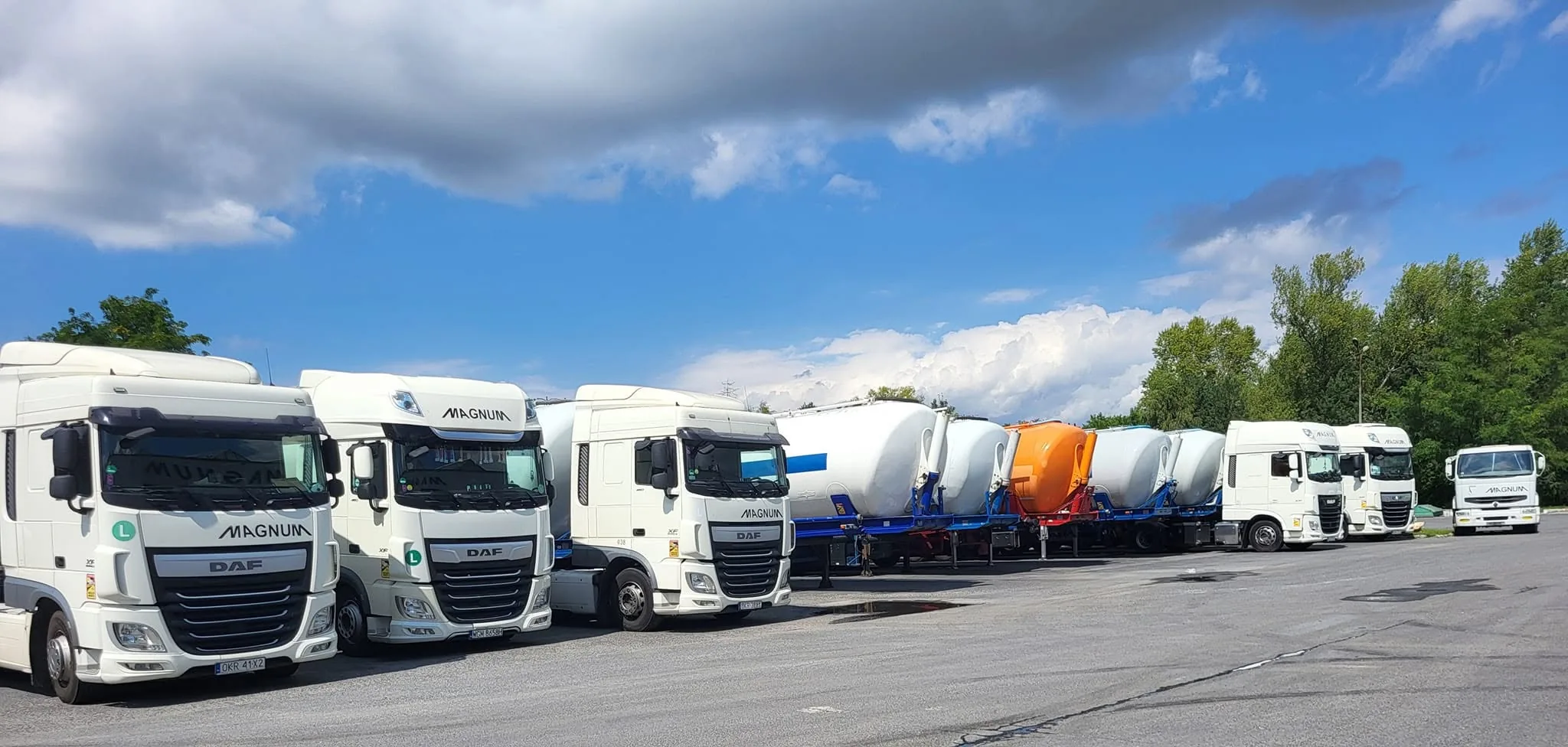
PHS Magnum keeps 2-3 silo trailers dedicated exclusively to carbon black within our fleet of 31. The vehicles are internally marked “carbon black only” — they never return to light-coloured materials.
Reinforced dust filters
- Carbon black particles measure 10-500 nm
- Standard dust filters (≤10 µm) are not enough
- HEPA class H13 filters are required (≥99.95% efficiency at 0.3 µm)
- Replaced every 3-6 months
Reinforced seals
- Industrial EPDM with a higher Shore A hardness
- Replaced every 18-24 months (fine carbon black particles penetrate the pores of softer rubbers)
Loading procedure
- Pneumatic loading from the shipper’s silo
- The driver wears appropriate personal protective equipment (gloves, goggles, a P3 dust mask)
- After loading — an external visual check of the silo trailer (no carbon black spills around the loading point)
- An entry in the cycle register
Unloading procedure
- Pneumatic discharge at the customer
- After discharge — an internal tank cleanliness check (carbon black clings to surfaces)
- The tank can never be cleaned completely — residual carbon black is normal in dedicated silo trailers
Safety
- Carbon black at high airborne concentrations can be explosive (classified as an explosive dust)
- During loading/unloading the driver wears a dust mask; no smoking and no open flames within 10 m
- The safety procedure follows the material’s SDS
Carbon black transport economics
Because of its low density (0.2-0.4 g/cm³), carbon black hits the silo trailer’s volumetric limit, not the weight limit:
- A 55–65 m³ silo trailer = 12-24 tonnes of carbon black (vs 27 tonnes of PET granulate)
- Fewer tonnes travel per run, which shapes the per-tonne economics — ask us for a quote for your specific route and volume
For regular contracts with major shippers (Birla, Orion, Cabot), we can prepare a tailored volume-based quote.