Key takeaways
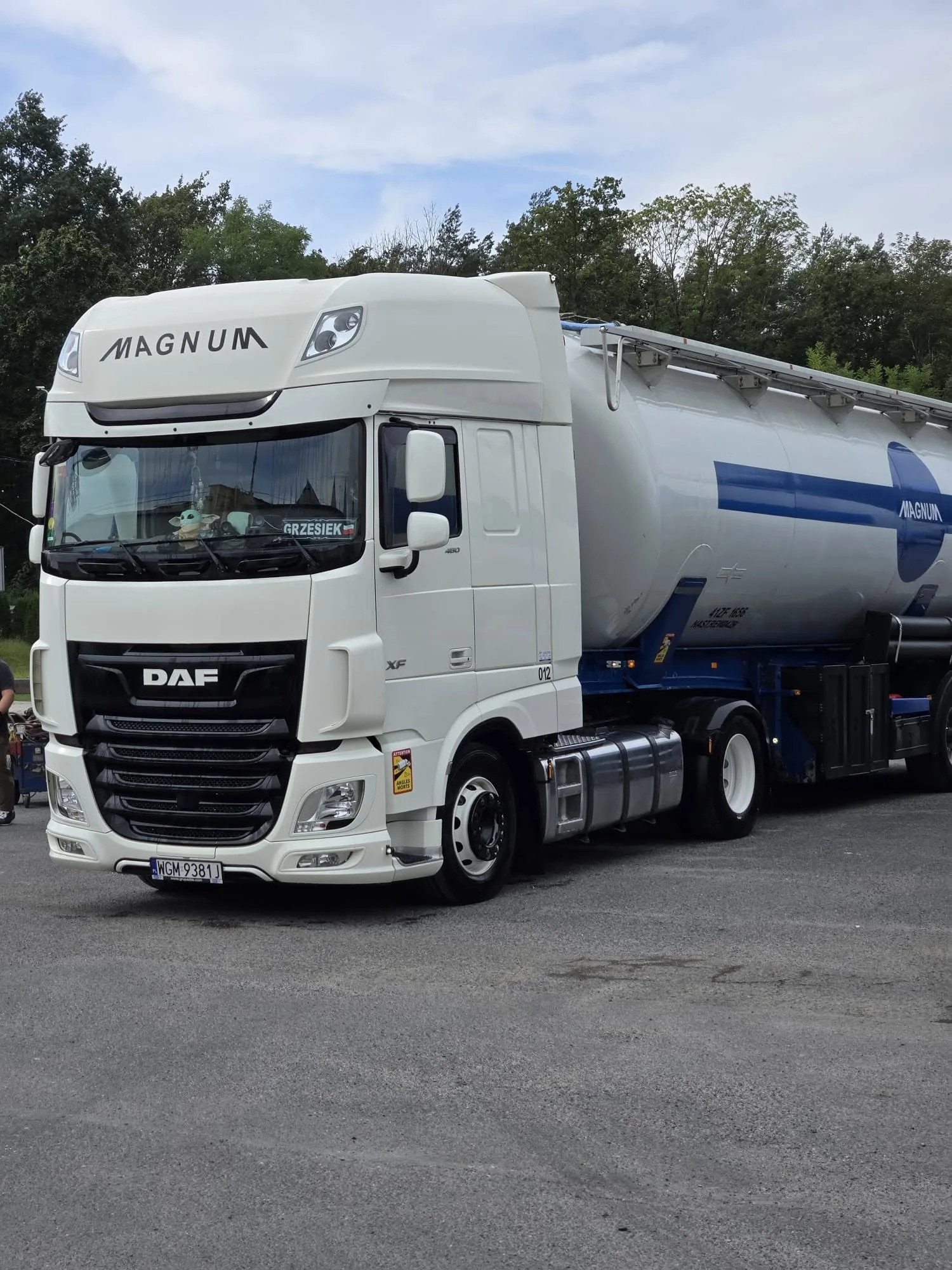
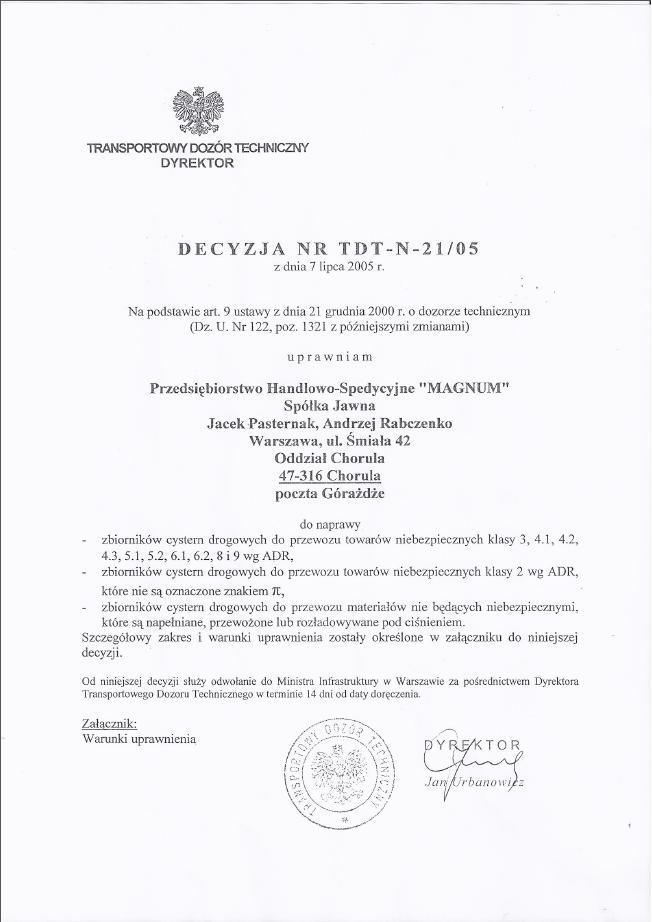
ADR tankers — vehicles for carrying dangerous goods. They require an ADR approval certificate + driver qualifications + TDT documentation. PHS Magnum provides ADR tanker service in Chorula — inspections and tank repairs under TDT-M/N authorisations valid until 2030.
| Requirement | Element |
|---|---|
| Vehicle approval certificate | TDT (X/Y/Z), valid 1 year |
| ADR driver certificate | 18h course + 12h tank course, valid 5 years |
| Health record book | Examinations every 5 years (from age 55 every 3 years) |
| Transport documentation | CMR + ADR document + written instructions |
| Marking | Orange plates + class labels |
| Emergency equipment | Fire extinguisher, absorbent bags, shovel, blanket |
TDT tanker service phone: +48 504 788 385
What ADR tankers are
ADR tankers are heavy vehicles with tanks designed for transporting dangerous goods classified under ADR (Accord européen relatif au transport international des marchandises Dangereuses par Route). The tank design and equipment must meet the requirements of the European ADR agreement — updated every 2 years (latest version: ADR 2025).
The difference: tanker vs silo trailer
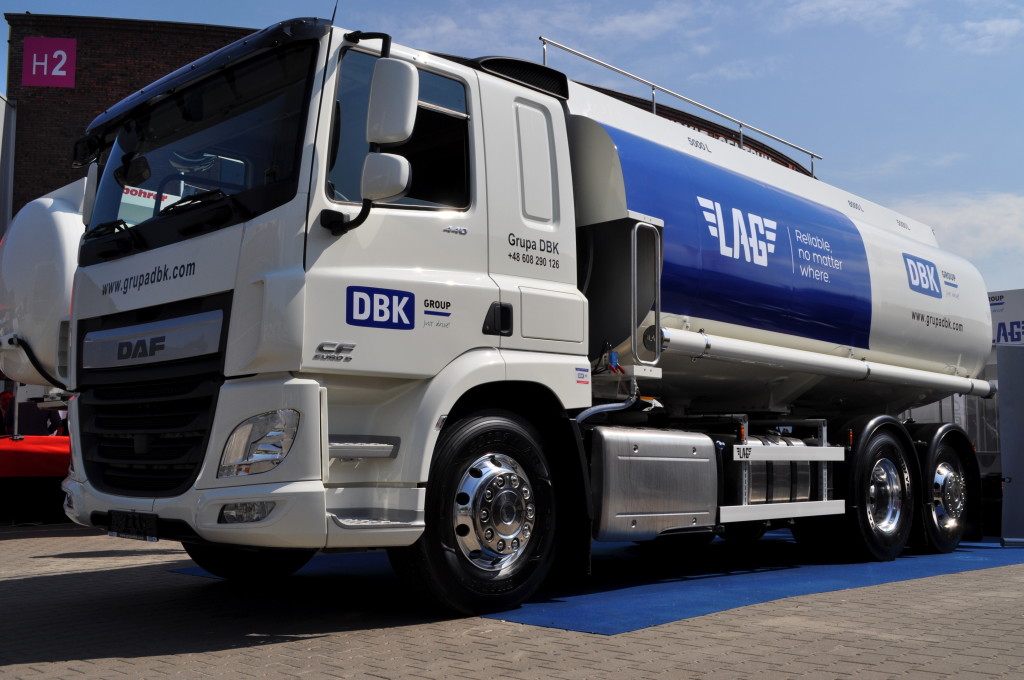
- Tanker — a horizontal tank for liquid or semi-liquid materials (fuels, acids, milk). Gravity or pump discharge.
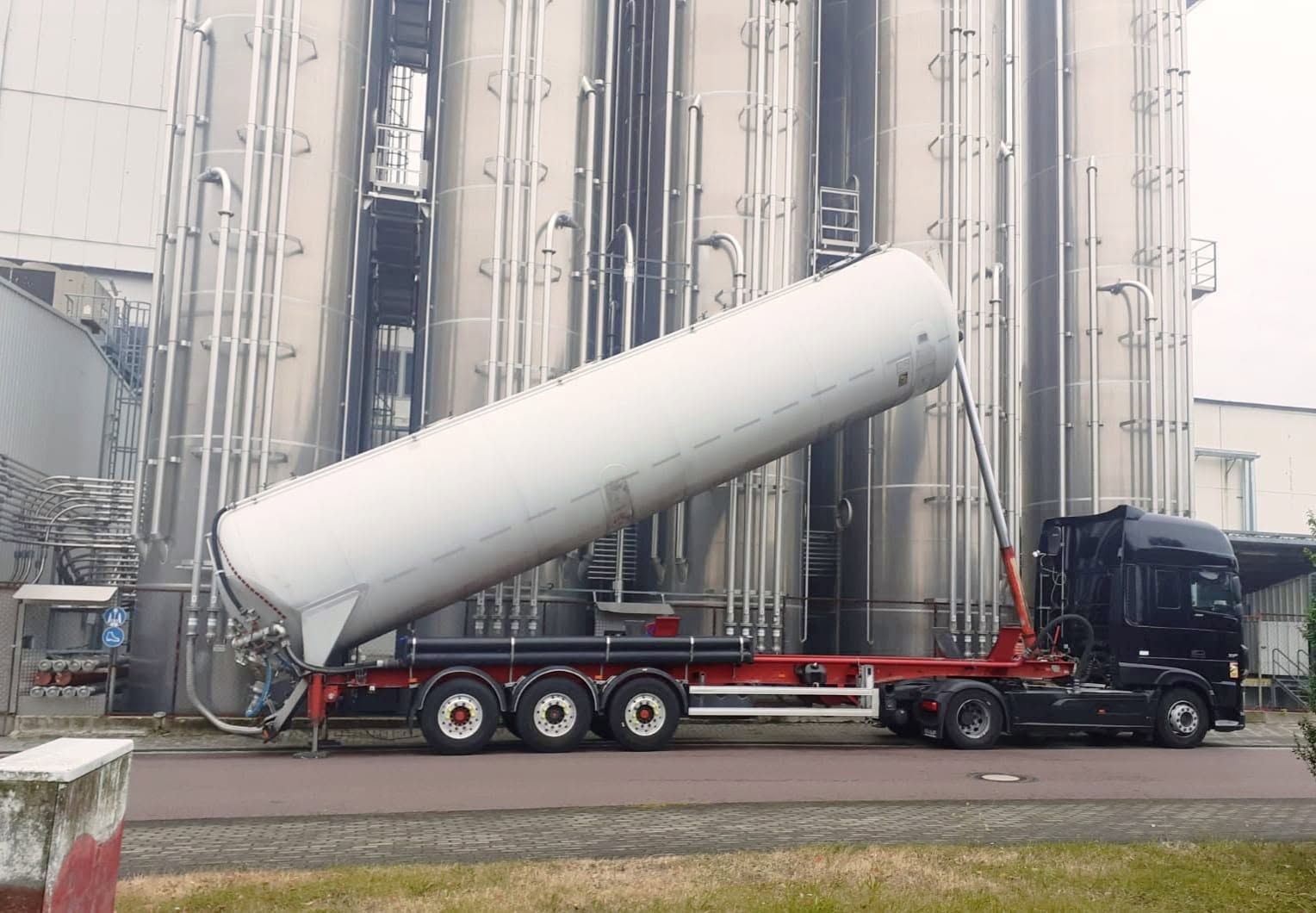
- Silo trailer — a vertical/tilted tank for dry bulk materials (granules, minerals). Pneumatic discharge.
Most ADR tankers carry liquids (fuels, chemicals); some carry ADR dry bulk (flammable carbon black of class 4.1, certain forms of lime of class 8).
Comparison details: Tanker vs silo trailer .
ADR classification — 9 classes
| Class | Materials | Frequency in tankers |
|---|---|---|
| 1 | Explosives (ammunition, pyrotechnics) | Rarely carried in tanks |
| 2 | Gases (LPG, LNG, oxygen, chlorine, ammonia) | Special pressure tankers |
| 3 | Flammable liquids (petrol, diesel, aviation fuel, ethanol) | Fuel tankers (the most common) |
| 4.1 | Flammable solids (sulphur, technical carbon black) | Some dry-bulk tankers |
| 4.2 | Spontaneously combustible (yellow phosphorus) | Rarely carried in tanks |
| 4.3 | Emitting flammable gas in contact with water | Rarely carried in tanks |
| 5.1 | Oxidisers (hydrogen peroxide, nitrites) | Chemical tankers |
| 5.2 | Organic peroxides (highly reactive) | Special chemical tankers |
| 6.1 | Toxic (arsenic, cyanides, pesticides) | Chemical tankers |
| 6.2 | Infectious (medical samples) | Specialist medical transport |
| 7 | Radioactive (isotopes, radioactive materials) | Specialist vehicles |
| 8 | Corrosive (acids, bases, lime) | Chemical tankers (common) |
| 9 | Miscellaneous (lithium batteries, hot liquids) | Special chemical tankers |
Technical requirements for an ADR tanker
Tank with ADR certificate
The code designation (X, Y, Z) describes the permitted classes:
- X — broad application, low-risk materials
- Y — limited application, medium-risk materials
- Z — narrow application, high-risk materials (e.g. class 5.1 oxidisers)
Safety valves
Approved separately for the given ADR class. Standard actuation pressures:
- Fuel tankers (class 3): 0.5-1.5 bar
- Chemical tankers (class 8): 0.3-3.5 bar depending on the medium
- Gas tankers (class 2): depending on the type of gas (LPG, LNG, chlorine)
TDT seals on manholes
Tamper-proof seals verified at every inspection. A broken seal = the vehicle is withdrawn until rectified.
External marking
- Orange plates with the Kemler hazard code (4 upper digits) and the UN number (4 lower digits)
- Class labels (diamond-shaped, coloured — e.g. red for class 3, yellow for class 5)
- Registration number clearly legible
Emergency equipment
- Fire extinguisher ABC + CO₂ specific to the class
- Absorbent bags (chemical sorbents)
- Shovel
- Fire blanket
- Gas mask (for classes 2 and 6)
- Protective boots + coverall (for class 8 corrosives)
- ATEX-EX torch for classes 3 and 4 (flammables)
The ADR approval certificate
Issued by TDT, A4 format, with a photograph of the vehicle. It contains:
- Registration number and VIN
- Classes permitted for carriage
- Maximum load
- Restrictions (e.g. aluminium or steel tank only)
- Validity date (1 year from the last inspection)
Without a valid certificate the vehicle may not be operated as an ADR tanker — the road transport inspectorate spots this immediately at the first check.
Driver qualifications
ADR training certificate
Two basic courses:
1. ADR basic course (18 hours)
- Legal part (ADR regulations, classification)
- Dangerous goods classes
- Emergency procedures (written instructions)
- Documentation
- Examination
2. ADR tank course (12 hours)
- Design of ADR tankers
- Loading and unloading
- Personal protective equipment
- Spill procedure
- Examination
Plus specialist courses (classes 1, 7) — for explosives and radioactive materials.
The certificate is valid for 5 years, then a refresher course (8-16 hours) is required.
ADR health record book
Medical examinations every:
- 5 years (up to age 55)
- 3 years (age 55-65)
- 1 year (over 65)
Checked: vision, hearing, memory, reaction times, mental health.
Certificate of professional competence
Standard for professional drivers + the ADR endorsement.
Procedure after an ADR tanker accident
Step 1: Securing the scene
- Stopping the vehicle in a safe place
- Switching on the hazard lights
- Putting on a high-visibility vest
- Setting up warning triangles (50-150 m)
Step 2: Calling for help
112 + information about:
- ADR class (1-9)
- UN number from the transport document
- Precise location (GPS, road km)
- Condition of the driver, any casualties
Step 3: Actions according to class
The ADR written instructions (on board) contain procedures for each class:
- Class 3 (fuels): keep away from ignition sources, do not use water on the fire (fuel floats on water)
- Class 8 (acids): do not approach without a coverall and mask, neutralisation by specialists
- Class 2 (gases): evacuation within a radius depending on the gas (LPG 100 m, chlorine 500 m+)
- Class 6 (toxic): gas mask, evacuation of the area
Step 4: Report
Within 24 hours, a written report to:
- The employer
- The insurer
- The road transport inspectorate (if requested)
- The material manufacturer
ADR tanker service at PHS Magnum
PHS Magnum provides a complete ADR tanker service in Chorula with TDT-M/N authorisations valid until 14.04.2030:
Periodic TDT inspections
- Vehicle preparation (2-3 working days)
- Increased pressure test (1.3× MOP)
- Internal inspection with PT weld testing
- Safety valve calibration
- Attendance of the TDT inspector (0.5-1 day)
- Issue of the ADR certificate (valid 1 year)
Tank repairs
- Welding of circumferential welds (TDT authorisations)
- Section replacement in case of serious damage
- Accident repairs with documentation for the insurer
- Modernisations (change of class, of operating pressure) — agreed with TDT
Stainless steel passivation
For chemical tankers made of 304L/316L steel after welding repairs — full passivation with 30% nitric acid + cleanliness protocols Ra ≤ 0.8 µm.
Safety valve repair
Replacement, calibration, documentation for TDT.
Paint renovation
Anti-corrosion coatings for ADR tankers — resistant to contact with the class medium.
Contact
ADR tanker service — TDT coordinator:
📞 +48 504 788 385 (Roland Sobota)
📞 +48 602 716 551 (general dispatcher)
Workshop address: ul. Kościelna 9, 47-316 Chorula, Poland
4 km from the A4 Gogolin junction · 180 km from the German border
TDT authorisations: TDT-M/N-19/22 (amended T.5900.63.2026.T22.1)
Valid: until 14.04.2030
Related: Tanker vs silo trailer — differences · ADR transport by silo trailer · Tanker service · TDT inspections of tankers · TDT supervision of concrete pumps