In brief
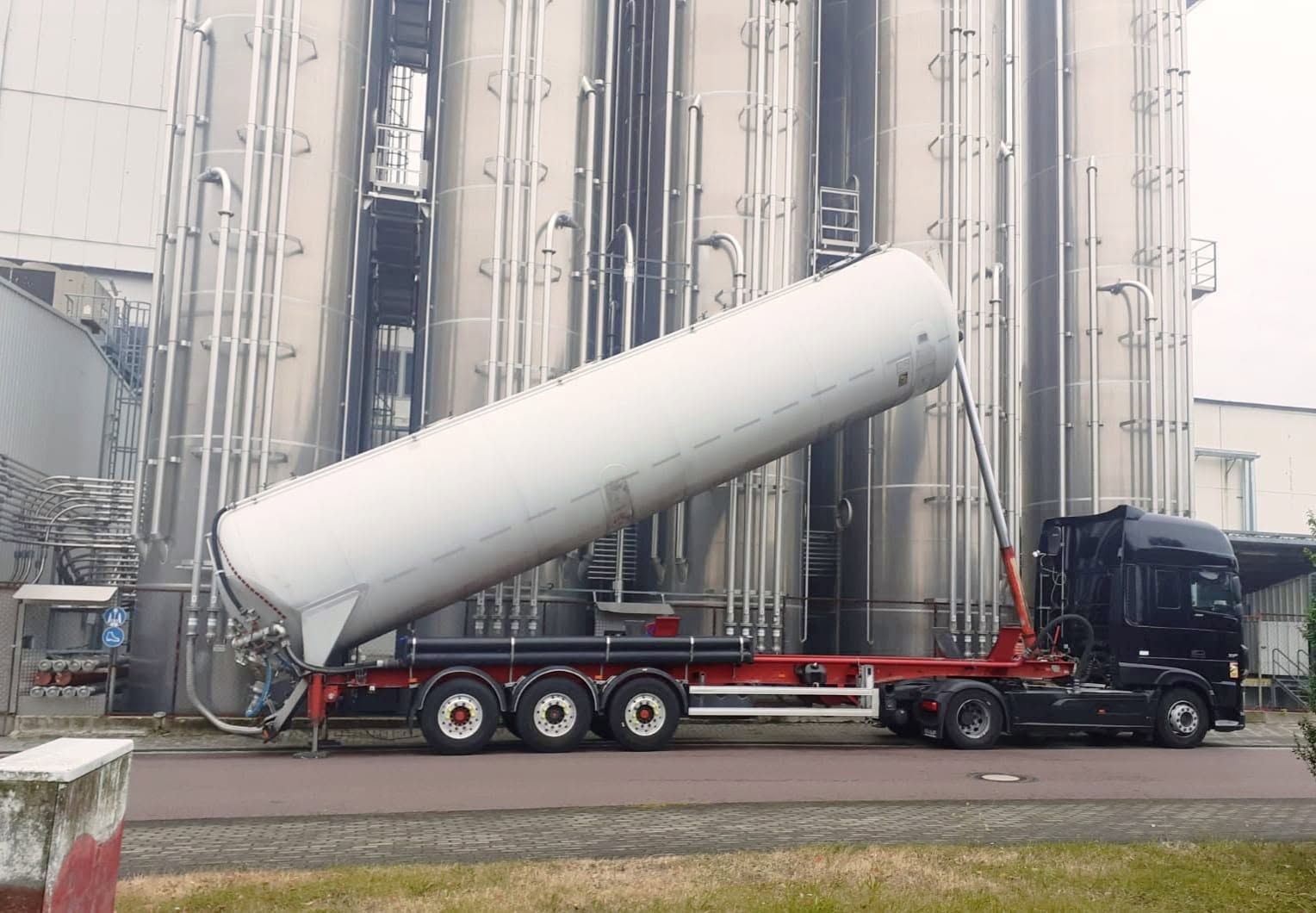
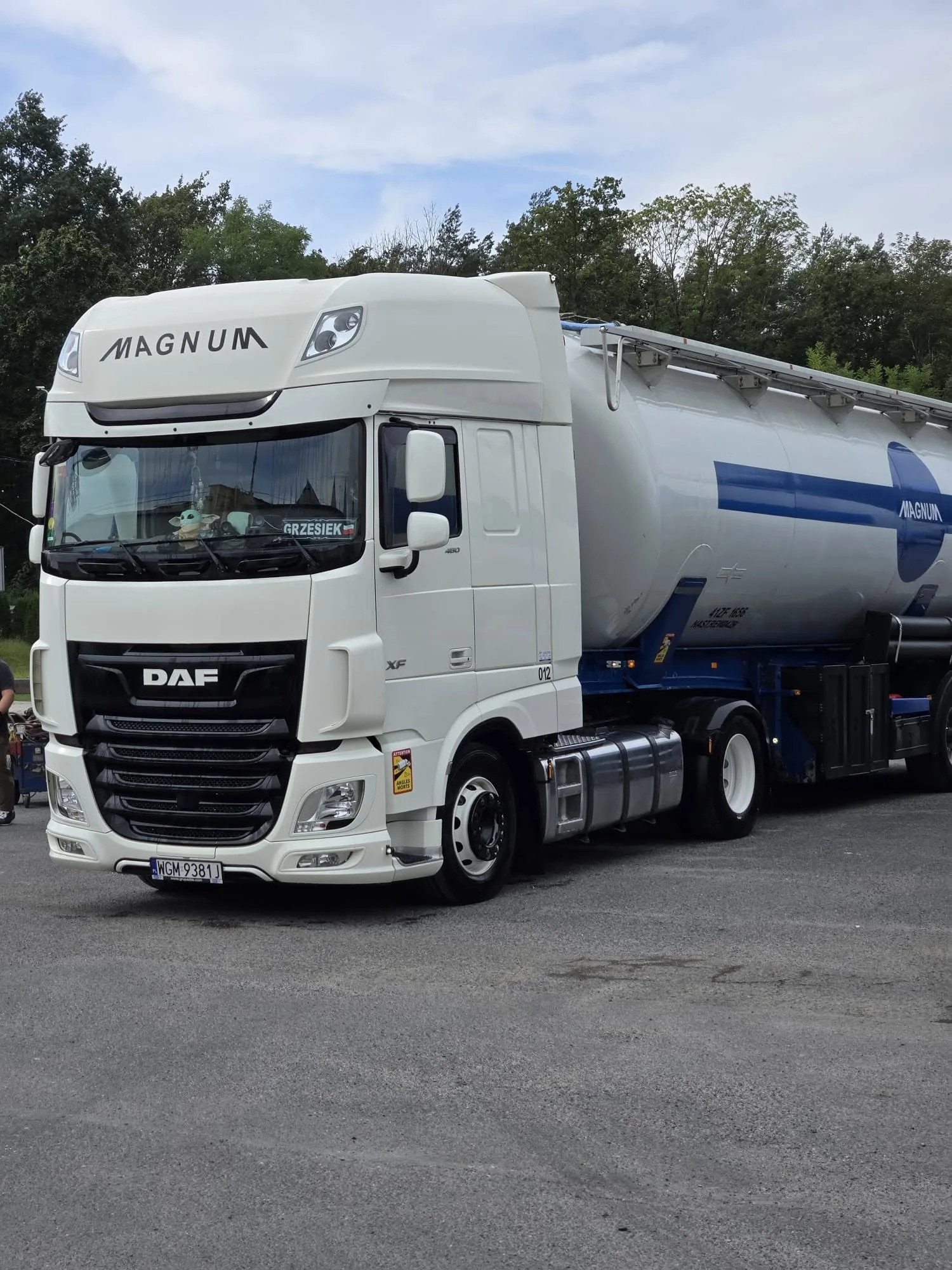
A PHS Magnum silo trailer (60 m³, payload 25-27 t) handles 18 bulk material groups — from premium polymers to industrial minerals. The decision on whether a material suits the transport is based on three criteria: particle size (0.1-10 mm), bulk density (0.4-1.8 g/cm³), compatibility with the aeration system.
| Category | Number of groups | Typical loading capacities |
|---|---|---|
| Virgin polymer granulates | 10 | 22-26 t (PE/PP/PVC/ABS/PET/PS/PC/PA) |
| Regranulates | 4 | 20-25 t (rPET/rHDPE/rPP/rPE) |
| Industrial minerals | 5 | 23-28 t (lime/talc/chalk/bentonite/Tonsil) |
| Other chemical bulk | 3 | 22-27 t (urea, carbon black, coal dust) |
Polymer granulates — our main specialisation
Polyethylene (PE)
- PE-LD (Low Density) — film industry, flexible packaging. Density 0.55 g/cm³, payload 22-24 t.
- PE-HD (High Density) — bottles, containers, pipes. Density 0.62 g/cm³, payload 24-26 t.
- LLDPE (Linear Low Density) — reinforced films, heavy-duty packaging. Density 0.55-0.60 g/cm³.
Clients we serve: LG Chem, HTNS, Borealis, INEOS, LyondellBasell, Synthos.
Polypropylene (PP)
- PP-H (Homopolymer) — rigid packaging, fibres, RP. Density 0.55 g/cm³.
- PP-Co (Copolymer) — containers, impact-resistant automotive parts.
- PP-Random — transparent film, bottles.
Producers: Sabic, Borealis, Synthos, INEOS Olefins.
Suspension and emulsion PVC
Producers: Vinnolit, Ineos Vinyls. Particle size 50-200 µm (S-PVC) or 0.1-1 µm (E-PVC). Requires a special loading procedure — the fine particle size distribution causes dusting.
PET, PS, ABS, PC
- PET bottle-grade — Indorama, Plastiverd. Hygroscopic.
- PS GP, HIPS — Synthos, INEOS Styrolution.
- ABS — Sabic, Trinseo. A rubber-styrene blend.
- PC (Polycarbonate) — Covestro, Sabic. Premium grade, cleanliness requirement.
Polyamides PA6, PA66 (special moisture requirements)
Lanxess, BASF, Domo Chemicals. The most difficult material for bulk transport due to hygroscopicity. PHS Magnum handles it, but we require:
- Notification 72h before loading
- RH check at loading <40%
- Maximum transit time 48h
- Moisture certificate on the CMR
Regranulates — a growing segment
Trade in secondary polymer materials is growing following the EU 2030 requirements (30% recycled feedstock). PHS Magnum handles:
- rPET — from post-consumer PET bottles, for new bottles (bottle-to-bottle)
- rHDPE — from rigid packaging
- rPP — from food packaging after hygienic washing
- rPE — from post-production films
The specifics of regranulates: greater batch variability than virgin grades. The standard PHS Magnum procedure:
- Visual inspection at loading (the operator looks for foreign bodies, foreign colours)
- Optional 1-10 mm screening at the SMIALA terminal (when the customer requires a guaranteed fraction)
- Full source batch documentation on the CMR
Industrial minerals
Hydrated lime Ca(OH)₂
Main applications: flue gas cleaning (DeSOx in power plants), acid neutralisation in the chemical industry, coagulation in water treatment. Bulk density 0.55-0.65 g/cm³ (loose) or 1.2 g/cm³ (compacted). Typical payload: 24-28 t.
Note: lime is strongly alkaline — we require wet chamber washing before the next polymer load.
Talc
Cosmetics, paper, rubber and plastics industries (filler). Density 0.3-0.8 g/cm³ depending on the grinding grade. Payload: 22-25 t.
Bentonite
Foundries (sand moulds), drilling (mud), household chemicals (absorbents). Density 0.8-1.1 g/cm³. Hygroscopic — requires airtight transport.
Ground chalk (CaCO₃)
Fillers for plastics, paper, paints, adhesives. Density 0.9-1.4 g/cm³ depending on grinding. Payload: 25-28 t.
Tonsil 571 FF
A specialised bleaching earth for refining edible oils (e.g. palm oil, sunflower oil). Density 0.55 g/cm³. Payload 24 t. Requires a food-grade chamber washing procedure.
Other bulk materials
Urea CO(NH₂)₂
Agricultural fertilisers (47% N), plasticisers, AdBlue (32.5% solution). Density 0.7 g/cm³. Hygroscopic but less demanding than PA. Payload: 24-26 t.
Carbon black
Tyre and rubber industries, inks, plasticisers. Very low density 0.3-0.5 g/cm³ — often a volume limitation (fills 60 m³ at 18-25 t).
Note: carbon black is a dusty material — it requires particular care about chamber tightness and washing before other materials.
Coal / fuel dust
Power generation (pulverised solid fuels), some chemical applications. Density 0.5-0.8 g/cm³. ADR documentation required if in a flammable class.
What we do NOT carry — and why
This is a deliberate business decision:
- Cement — very difficult to clean completely out of the chamber. After a single cement load, a silo trailer loses the ability to handle premium PE/PP granulates for many weeks (residue in the aeration pads). Customers such as Borealis, Synthos, LG Chem have a “no cement history” clause in their contracts.
- Construction gypsum — a similar problem to cement + additional moisture.
- Flour, animal feed — requires a dedicated fleet with a food-safe HACCP certificate, which we do not hold. Specialised companies serve this segment.
- Silica, metal sulphates — highly abrasive, they destroy the aeration pads and the chamber. After 5-10 silicate loads the pads require replacement.
- Fine aggregates < 0.5 mm — dusting clogs the filters, generates static, requires specialised ATEX-EX silo trailers.
- Moist materials (moisture >0.5%) — they clog the aeration system, impossible to unload pneumatically.
Matching the silo trailer to the material
PHS Magnum has 3 silo trailer brands in the fleet — the choice depends on the material:
| Brand | Tank material | Best for |
|---|---|---|
| Schmidt Polska 60 | Painted steel | PE/PP/PVC granulates, regranulates, minerals |
| Spitzer (SF series) | Aluminium EN AW-5083 | High-purity PE/PP, food-grade |
| Feldbinder (EUT) | Stainless steel 304L/316L | Corrosive materials, premium chemicals |
For food-contact materials (PET, medical PA, PS for food packaging) we prefer the Spitzer SF series (aluminium = easier inspection and washing) or the stainless Feldbinder. For minerals (lime, chalk) the standard is Schmidt Polska.
Ordering transport of a specific material
The best workflow for a new material or an unusual load:
- Material specification — send the Material Safety Data Sheet (MSDS) + Technical Data Sheet (TDS) with parameters: bulk density, particle size, ADR class, tolerable moisture, storage temperature
- Preliminary assessment — whether it fits our infrastructure, compatibility with the silo trailer’s previous loads
- Trial run if needed — a first trial (1-2 transports) with additional documentation, possible process adjustments
- Standard contract — a contract rate for regular deliveries
Transport dispatcher phone: +48 602 716 551 .
Related: Silo transport — a guide · Tanker vs silo trailer · Silo trailer cleaning · Granulate transport from the port of Gdańsk · Mineral transport by silo · Transport — main page · Big-bag transloading