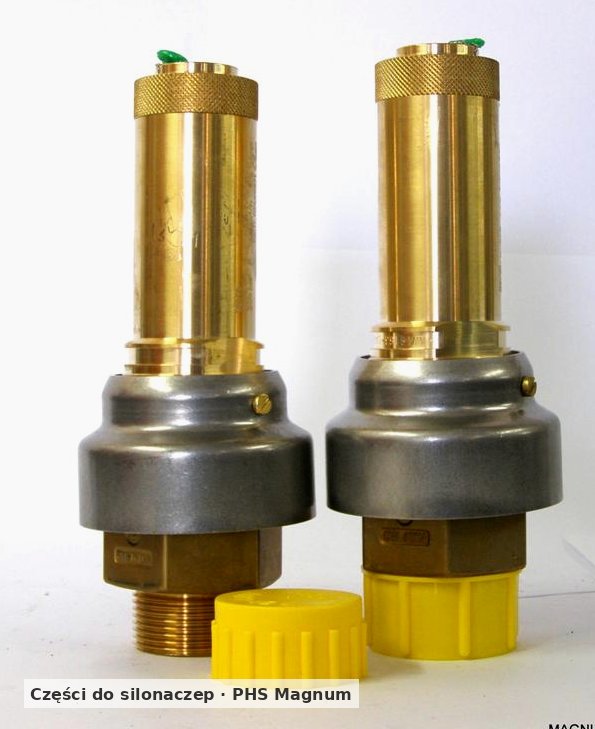
Safety valves for multi-brand fleets
PHS Magnum has served fleets of silo trailers from various European manufacturers since 1991, and the safety valve is the component they all share. Regardless of the tank make, the pressure system works on the same principle: during aeration and pneumatic discharge, compressed air fluidises and conveys the bulk material, and the safety valve is the last line of defence against exceeding the permissible pressure. It opens at the set value and vents the excess air, protecting the tank, the fittings and the operator.
As a network serving many makes, we do not select parts against a single manufacturer’s catalogue, but against the actual installation of the specific vehicle. Our range includes safety valves made by Herose, intended for installation on the silo and on the compressor. The body is made of brass, the seal of Viton, and every unit is supplied with a quality control certificate. Two temperature versions are available — up to 200°C and up to 150°C — chosen according to how the given trailer’s compressor circuit works.
Technical specification
The offered valves are the compressor version, without a shroud flange. Parameters of both temperature versions below.
200°C version
| Feature | Value |
|---|---|
| Manufacturer | Herose |
| Application | compressors, without shroud flange |
| Body material | brass |
| Seal | Viton |
| Max. operating temperature | 200°C |
| Quality control certificate | yes (technical documentation and certificate) |
| Thread (inches) | 1 1/4, 1 1/2 |
| Set pressure (bar) | 2; 2.3; 2.5; 2.6 |
150°C version
| Feature | Value |
|---|---|
| Manufacturer | Herose |
| Application | compressors, without shroud flange |
| Body material | brass |
| Seal | Viton |
| Max. operating temperature | 150°C |
| Quality control certificate | yes (technical documentation and certificate, F/K/S) |
| Thread (inches) | 1, 1 1/4, 1 1/2 |
| Set pressure (bar) | 1; 1.2; 1.5; 2; 2.3; 2.5; 2.6; 2.8 |
Both variants are selected by two parameters: the thread (in inches) and the set pressure (in bar). The following types are available:
200°C version — available types (thread / set pressure):
| Thread (inches) | Set pressure (bar) |
|---|---|
| 1 1/4 | 2 |
| 1 1/4 | 2.3 |
| 1 1/4 | 2.5 |
| 1 1/2 | 2 |
| 1 1/2 | 2.3 |
| 1 1/2 | 2.5 |
| 1 1/2 | 2.6 |
150°C version — available types (thread / set pressure):
| Thread (inches) | Set pressure (bar) |
|---|---|
| 1 | 2 |
| 1 | 2.3 |
| 1 1/4 | 1.2 |
| 1 1/4 | 2 |
| 1 1/4 | 2.3 |
| 1 1/4 | 2.5 |
| 1 1/4 | 2.6 |
| 1 1/2 | 1 |
| 1 1/2 | 1.2 |
| 1 1/2 | 1.5 |
| 1 1/2 | 2 |
| 1 1/2 | 2.3 |
| 1 1/2 | 2.5 |
| 1 1/2 | 2.8 |
We select the specific setting for a given trailer from the above range based on the installation documentation — the valve setting must match the system’s working pressure and is verified at the TDT inspection.
Compatibility with silo trailer makes
Herose safety valves fit the pneumatic systems of silo trailers of various makes, because threaded connections without a shroud flange are the typical solution on the European market. In service practice we match them to, among others:
- Spitzer SF/SK — the non-tipping (SF) and tipping (SK) series; the valve protects the tank during pneumatic and aerated discharge.
- Feldbinder EUT/KIP — horizontal trailers (EUT) and Kippsilo tipping silos (KIP) with a hydraulically lifted tank.
- Kässbohrer K.SSK/K.SSL — silo trailers for bulk materials and granulates.
- Other European manufacturers — we handle the remaining fleets individually, without a model catalogue, selecting the valve according to the vehicle’s documentation.
In all these vehicles, the deciding factor is not the make but the set pressure. Silo trailer safety valves fall under TDT supervision, and the set pressure is a critical parameter verified by the inspector during the inspection. The valve must open only when the permissible value is exceeded, while at the same time not cutting into the working discharge pressure. For this reason the setting is never established “by eye” — we match it to the working pressure of the specific installation and confirm it with the vehicle documentation. A valve without a current quality control certificate is a problem at the TDT inspection, which is why a complete set of documents accompanies every unit.
Warehouse in Chorula
We supply Herose safety valves in both temperature versions (200°C and 150°C) from the PHS Magnum warehouse in Chorula near Opole, 4 km from the A4 motorway. We stock what actually moves in the service of multi-brand fleets; non-standard settings and threads are sourced via direct delivery. Thanks to the location by the A4 we ship by courier within Poland and deliver to EU countries, and for typical settings personal collection is possible.
In practice, the safety valve is a component that wears slowly and imperceptibly — over time the setting can drift and the Viton seal can harden, causing the valve to open too early or too late. Both scenarios are dangerous: opening too early prolongs discharge and wastes air, opening too late endangers the tank. That is why we treat safety valves as periodically verified parts, not “fit and forget”. When ordering, please state the connection thread and the target set pressure resulting from the vehicle documentation; if you do not have them, we help establish them based on the installation’s working pressure.
Selection of the setting and thread for the installation, and valve checks, are carried out as part of our silo trailer service . We do not quote invented set values or service-life mileages — they depend on the working pressure and operating conditions of the specific trailer.
Selecting parts in mixed-brand fleets
The safety valve is the best example of why, in a mixed fleet, it pays to select fittings by parameters rather than by trailer make. In Spitzer SF/SK designs the protection covers the tank during pneumatic and aerated discharge — what matters here is the compressor circuit and its temperature, which determines the choice of the 150°C or 200°C version. On Feldbinder trailers the arrangement is twofold: on the horizontal EUT the valve protects the tank during aeration and pneumatic discharge, while on the KIP tipping silo — during pressure discharge with the tank hydraulically raised, where reliable operation is particularly important. On Kässbohrer K.SSK/K.SSL silo trailers the selection principle is the same: the Herose valve is matched to the thread and setting of the given point, regardless of the factory designation.
Comparatively, then, the differences between makes lie not in the valve itself, but in how the circuit it is meant to protect works. That is why a mixed fleet does not stock separate “Spitzer” or “Feldbinder” valves, but selects a common component by two parameters — the thread in inches and the setting in bar — confirmed by the documentation of the specific vehicle.
The role of the central warehouse in the network
The central warehouse in Chorula makes it possible to serve the entire mixed fleet with one proven range of Herose valves instead of running separate procurement for each make. This matters precisely for a safety component: stock held on hand with complete documentation shortens the time between the decision to replace and returning the trailer to work, while the lack of a current quality control certificate can stop a vehicle at the TDT inspection. Thanks to the location by the A4, typical settings and threads reach both destinations deep inside the country and the DACH market quickly, with direct delivery closing the gap for non-standard items.
What to watch for across makes
- The nature of the compressor circuit — with an intensively worked system the 200°C version is the sensible choice; where temperatures stay lower, the 150°C version with the F/K/S certificate suffices.
- Pressure discharge versus pneumatic discharge — on tipping silos the reliability of the setting is critical, so selection follows the vehicle documentation strictly.
- A complete set of documents at the TDT inspection — regardless of make, a quality control certificate accompanies every unit, because it is what decides whether the inspection is passed.
- Two installation points — on every make the valve is fitted both on the silo and on the compressor circuit; when ordering, it is worth distinguishing which point the replacement concerns.
- Interchangeability within the fleet — with a mixed fleet (Spitzer SF/SK, Feldbinder EUT/KIP, Kässbohrer K.SSK/K.SSL) the same setting type is often shared by several vehicles, which simplifies keeping one reference instead of a separate item for each make.
- Identification by setting, not by logo — in service practice the valve is selected by the set value and installation point read from the vehicle documentation, not by the trailer manufacturer; this framing distinguishes the hub catalogue from the brand catalogues.
- Planned replacement at the TDT inspection — the inspection date is a good opportunity to assemble, in one order, valves for several trailers of different makes undergoing inspection around the same time.
Specialist portals
For selected makes we run dedicated parts catalogues with a narrower, brand-specific technical context:
- Spitzer — safety valves for Spitzer SF/SK silo trailers
- Feldbinder — safety valves for Feldbinder EUT/KIP silo trailers
Related categories
- Check valves — straight Europa-type and angle check valves in the pneumatic line
- Gestra RV check valves — disc check valves for wafer-type installation between flanges
- Storz system — couplings and fittings for the silo trailer discharge line
- Full spare parts catalogue
Author: Aleksy Pasternak — Managing Partner at PHS Magnum, 20 years in the industry, ISO 9001:2015 internal auditor (DEKRA).