Why a mixed fleet needs one coupling standard
This catalogue looks at the Storz system through the eyes of a company operating not a single brand, but a fleet of trailers from different manufacturers at once. Storz is not a “brand part” — it is a neutral, manufacturer-independent quick-coupling standard in which the lug engages and releases with a single movement of the hand, without a spanner or any tool. As a result, a coupling taken off one vehicle fits the connection point of a completely different one, provided the size and connection type match. For a carrier running mixed traffic this means one common language of discharge fittings and one common pool of spare parts instead of five separate ones — which at a pace of around 200 tonnes per day translates directly into downtime and the certainty of a secure lock on the connection.
The selection of a specific Storz item is never decided by the logo on the tank wall, but by three physical variables: the size and thread type of the fittings found on the given vehicle, the coupling material matched to the medium carried (aluminium for PE/PP granulates and other bulk materials, brass or stainless steel for demanding media), and the seal class. We apply the same three criteria identically to every brand in the fleet — and it is precisely this repeatability that lets us maintain one cross-cutting Storz range, from the stock offer in Polish aluminium to direct-supply, next-day items.
Technical specification
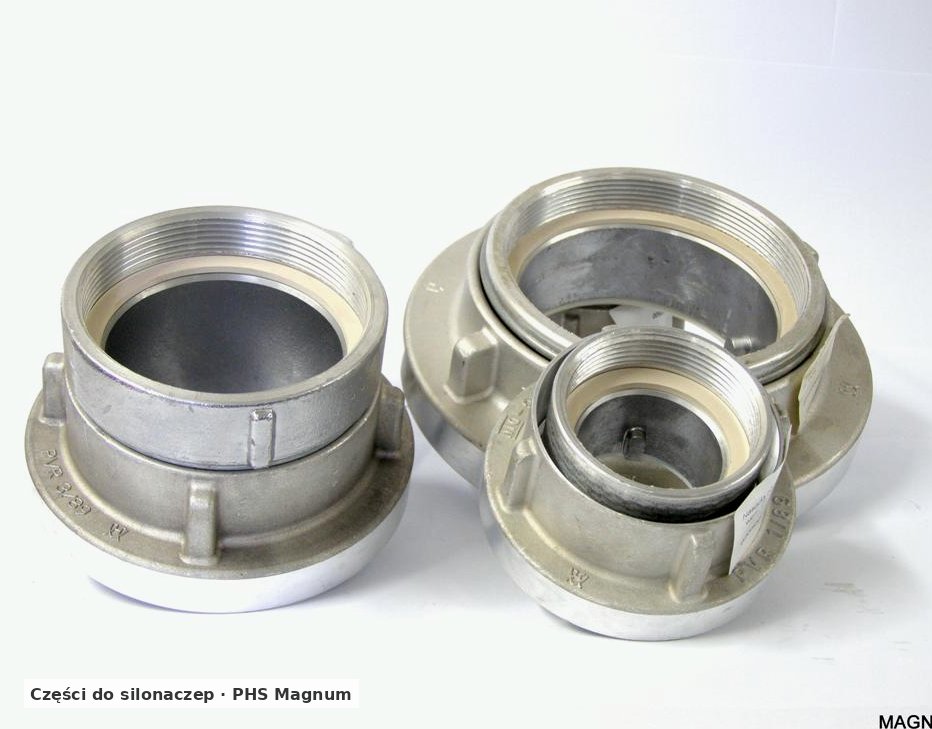
Couplings with female / male thread, swivel
| Execution | Standards / casting | Seal |
|---|---|---|
| Polish aluminium (basic offer) | AK 11 (AlSi 11) to PN-91/M-51031 | Black NBR |
| German aluminium | 14307, 14308, 14309 | White NBR |
| Brass | 14307, 14308, 1430, 86205 | White NBR |
| Stainless steel | 14307, 14308, 14309 | Green Viton |
| Swivel couplings | all sizes | per material |
The basic offer in Polish aluminium covers 2", 2 1/2", 3" and 4" threads in female and male executions.
Storz suction couplings
| Fitting method | Execution | Standard | Seal |
|---|---|---|---|
| GBS clamps | German aluminium | 14301, 14322, 14323 | White NBR |
| GBS clamps | German aluminium, steel hose tail | — | White NBR |
| GBS clamps | Stainless steel, size B(75) | 14307 | Green Viton |
| Shell clamps | all sizes | DIN 2817 | White NBR |
Blank caps and reducers
| Component | Execution | Standards | Seal |
|---|---|---|---|
| Blank cap | Polish aluminium AK 11 (AlSi 11) to PN-91/M-51031 | — | Black NBR |
| Blank cap | German aluminium | 14310, 14311, 14312, 14313 | White NBR |
| Reducer | Polish aluminium AK 11 | — | Black NBR |
| Reducer | German aluminium | 14341, 14342, 14343 | White NBR or silicone |
| Reducer | German aluminium with steel insert | 1434 | White NBR |
Storz system seals
| Sizes | Materials |
|---|---|
| C(52), B(75), A(110), 90, 100, D, 125, 150, 165, 205 | White NBR rubber; silicone (high temperature resistance); Viton (green) |
| Seals for female-threaded couplings | White NBR rubber; PTFE (reinforced) |
Storz system accessories
- hose tails for suction couplings — German aluminium with white NBR (standards 14301, 14321, 14322, 14323)
- hose tails for suction couplings — steel with white NBR, all sizes
- collars for suction couplings — Polish or German aluminium, all sizes
- securing rings for collars — steel
- cap chains — steel or stainless steel
The Storz system in mixed-brand fleets
Although the lug coupling is the same standard regardless of the trailer manufacturer, the route leading up to that coupling differs between brands — and it is this route, not Storz itself, that tends to cause confusion when matching parts in a mixed fleet. Storz defines the “hose side”: lug spacing, seal ring profile and nominal size. The “tank side” — what the coupling or hose tail ends in on the discharge fittings side — depends on the design of the specific series. In comparative practice it looks like this:
- Spitzer SF and SK — aluminium trailers with lightweight bodywork. The non-tipping SF series and the tipping SK run a pneumatic line in which Storz couplings and caps work on typical inch threads; here we match them primarily to the aluminium character of the fittings, making sure the seal and coupling material do not form an unfavourable galvanic pair with the tank’s light alloy.
- Feldbinder EUT and KIP — the horizontal EUT and the tipping KIP silo. This is where we most often encounter stainless steel terminations (food-grade versions) and executions for elevated working pressure; for this group we reach for stainless or aluminium couplings with a seal matched to the medium’s hygiene requirements more often than for the dry-granulate standard.
- Kässbohrer K.SSK and K.SSL — here we go solely by the measured size and thread type of the fittings on the given vehicle; because Storz remains brand-neutral, the matched coupling or reducer engages without modifications as soon as the inch size and connection profile agree.
The conclusion for the carrier is simple: in a fleet made up of several brands you do not assemble “Spitzer parts” or “Feldbinder parts” — you match Storz components by dimension and material, and the vehicle’s brand is merely a hint of what to expect on the fittings side.
It is also worth distinguishing two situations that get mixed up most often in conversations with customers. The first is replacing a component with an identical one — here the vehicle’s brand is irrelevant; only the measured dimension counts. The second is a deliberate change of material or seal class at the time of replacement, for example moving from a common execution to stainless steel when the vehicle changes its cargo profile. In both cases the neutrality of the Storz standard works in the carrier’s favour: the new component engages just as securely as the one removed, because the lug geometry is common to the entire silo trailer market. That is why a mixed fleet does not require separate know-how “per brand” — it merely requires measurement discipline and a conscious choice of material.
A central warehouse as the backbone of a multi-brand fleet
Keeping a mixed fleet service-ready differs from supplying a single-brand workshop. If each brand were served by its own stock, the carrier would have to tie up capital in five parallel sets of couplings, caps, reducers and seals — largely overlapping, because Storz is shared. A central warehouse at a single logistics hub reverses this logic: one cross-cutting Storz range serves the whole fleet, regardless of whether the trailer on the lift happens to be one brand or another.
We therefore build our stock levels around the real, aggregate operational wear of the whole fleet, not around a single manufacturer’s catalogue. The fastest-moving items — Polish aluminium couplings in typical threads, the full set of seals and blank caps — are kept in constant availability and issued off the shelf, cutting vehicle downtime to a minimum no matter which brand the part ends up on. Rarer items specific to particular configurations (stainless, brass, swivel executions) are replenished via direct supply, without burdening the permanent stock. This model — one central stock instead of many scattered ones — is the essence of the advantage a service-and-warehouse hub gives a mixed fleet: less tied-up capital, shorter response times and a single point of technical advice for the whole fleet.
Centralising the back office has one more, less obvious benefit: it gathers in one place the knowledge of what actually wears out in a given fleet. Servicing trailers of several brands in parallel, we see recurring patterns — which seal sizes move fastest, in which configurations contact corrosion keeps coming back, where it pays to keep a stainless execution in stock upfront rather than wait for a delivery. A single workshop looking at one brand cannot offer that perspective. That is why the central warehouse is not just a shelf of parts; it is the point where operational data from the whole fleet turns into more accurate matching and a shorter list of service surprises. For a carrier running mixed traffic this means predictability: the same supplier, the same coupling standard and the same back office serve every vehicle, whichever logo it carries.
What to watch for across brands
Before ordering a Storz component for a mixed fleet, it is worth going through a short checklist — we ask the same questions for every brand, because it is these, not the manufacturer, that decide the match:
- Measure, do not guess the size — check the thread type (female or male) and its dimension in inches on the specific vehicle; an identical series across different model years may have been ordered with different fitting sizes.
- Match the coupling material to the medium, not the brand — aluminium is the default for dry granulates and bulk materials regardless of manufacturer; reach for stainless steel or brass where hygiene or cargo aggressiveness requires it, most often in the food-grade versions found in part of the fleet.
- Watch the material pairing — in lightweight aluminium designs, avoid combinations that promote galvanic corrosion at the interface between the alloy and steel coupling components.
- Set the seal class by medium and temperature — universal rubber for typical applications, silicone at elevated temperatures, Viton for chemicals; this choice is common to all brands and independent of the logo on the tank.
- Check the line’s working pressure — in tipping and pressurised series, coupling tightness and seal fit are more critical than in simple gravity-pneumatic lines.
- State the type of seal currently fitted — when ordering, this is the fastest route to hitting a replacement component without modifying the fittings, whichever brand you are servicing.
- Distinguish the hose side from the fittings side — the measurement on the Storz lug side is common to the market, but the termination on the tank side depends on the series design; give both if in doubt.
- Account for the vehicle’s age — in overhauls of older vehicles, worn collars and worn lugs are more common, so besides the coupling the securing ring sometimes gets replaced too.
Quick comparison of differences between brands
The table below organises what — from a Storz selection perspective — to expect from each brand in a mixed fleet. The values remain qualitative; measurement on the specific vehicle always decides.
| Brand and series | Bodywork character | What to watch when selecting Storz |
|---|---|---|
| Spitzer SF / SK | aluminium, lightweight | coupling–alloy material pairing, typical inch threads |
| Feldbinder EUT / KIP | horizontal and tipping, partly food-grade | stainless executions, seal for hygiene and pressure |
| Kässbohrer K.SSK / K.SSL | per vehicle configuration | selection solely by measured size and thread type |
The table is an initial pointer, not a catalogue listing — in a mixed fleet we always confirm the selection by measuring the fittings found on the specific vehicle.
How to order a Storz part for a mixed fleet
To shorten the back-and-forth and hit the right component the first time, we ask for a set of information independent of the vehicle’s brand. When enquiring, the following help:
- nominal coupling size — read off or measured on the existing fittings, in inches;
- connection type — female or male thread, possibly a swivel execution;
- component type — coupling, suction coupling, blank cap, reducer or just the seal;
- expected material — aluminium, brass or stainless steel execution;
- seal class — for the medium and the line’s operating temperature;
- hose fitting method — for clamps or for shell clamps, if the enquiry concerns a suction coupling.
On this basis we match the replacement part without needing a brand or vehicle number — because in the Storz system it is the dimension and material, not the manufacturer, that unambiguously identify the component. If you service a fleet of several brands at once, a single such enquiry can cover items for different vehicles at the same time, and we will assemble them from one shared stock.
As a helpful step, before sending an enquiry it is worth gathering three things at the vehicle at once:
- the removed reference component or a photo of it with a ruler — the most reliable reference point when matching;
- information about the medium — what the vehicle actually carries, because this determines the material and seal;
- a note on the line’s working conditions — whether discharge is pressurised or gravity-pneumatic;
- the scope of the planned replacement — a single component or a complete connection, which lets us immediately match the fitting seals and accessories;
- the target deadline — whether the item is needed off the shelf from stock, or can wait for direct supply.
The benefits of one supplier for the whole fleet
- one point of contact — technical advice for all brands in one place;
- shared stock — no need to duplicate parts sets brand by brand;
- consistent quality standard — the same materials and the same selection criteria across the fleet;
- shorter downtime — the fastest-moving items issued off the shelf regardless of vehicle;
- predictable logistics — delivery and collection from a single base for every trailer in the fleet;
- fewer ordering mistakes — identification by dimension eliminates errors caused by mixing up different brands’ catalogues;
- operating history in a single record — knowledge of the whole fleet’s wear supports more accurate matching at subsequent replacements.
In short: in a multi-brand fleet the Storz system is not a brand feature but the common language of the fittings — and a central service-and-warehouse hub turns that shared standard into real savings of time and capital.
Compatibility with silo trailer brands
The Storz system is a cross-brand standard, which is why we match the same set of components to vehicles from different manufacturers. What decides is the thread size and seal type on the given vehicle, not the logo on the trailer.
- Spitzer (SF and SK series) — aluminium trailers; we match Storz couplings, caps and reducers to the pneumatic discharge line of the non-tipping SF and the tipping SK series.
- Feldbinder (EUT and KIP series) — horizontal EUT (including food-grade stainless steel executions, where we reach for Viton or white NBR) and tipping KIP silos working under discharge overpressure.
- Kässbohrer (K.SSK and K.SSL series) — we match Storz couplings on the discharge line to the thread and fitting size installed on these trailers.
- Other European manufacturers — we also serve fleets of other silo trailer brands found on the DACH market and in Poland; since Storz is a brand-independent standard, the key remains dimensional compatibility, not the vehicle’s manufacturer.
When ordering, please state the thread size (inches), the connection type and the material of the seal currently fitted — on this basis we will match a replacement component without modifying the fittings. Full category overview: spare parts .
Warehouse in Chorula
We run a permanent stock of Storz parts in Chorula near Opole, 4 km from the A4 motorway. We keep the basic offer in constant availability — Polish aluminium AK 11 couplings in 2"–4" threads, blank caps, reducers and the full set of NBR, silicone and Viton seals — so the most frequently replaced items can be issued off the shelf. Special items (German aluminium, brass, stainless steel, swivel couplings) come via direct supply, next-day.
We serve fleets of various silo trailer brands, so we build stock levels around real operational wear in mixed traffic, not around a single manufacturer’s catalogue. Courier delivery across Poland and to EU countries, with personal collection at the Chorula base also possible.
Specialist portals
For single-brand fleets we run dedicated portals with a Storz parts catalogue in the context of the given series:
Diagnostics and replacement are carried out as part of the PHS Magnum silo trailer service .
Related categories
- Pneumatic hoses — fitted to Storz suction couplings
- Hose clamps — GBS clamps and DIN 2817 shell clamps
- Ball seals — PTFE/NBR on the discharge line
- Check valves — in the silo trailer’s pneumatic line
- Full spare parts catalogue
Author: Aleksy Pasternak — Managing Partner at PHS Magnum, 20 years in the industry, internal auditor ISO 9001:2015 (DEKRA).