Pneumatic hoses for mixed-brand silo trailer fleets
This page is a cross-brand catalogue for the entire PHS Magnum network — we look at the pneumatic hose not from a single manufacturer’s perspective, but from the level of a workshop serving mixed fleets, where trailers of several brands run side by side. In fleet practice a haulier rarely operates a uniform fleet; more often they run aluminium and steel silo trailers, horizontal and tipping, food-grade and industrial, in parallel. The common denominator remains the physics of discharge: compressed air fluidises the bulk material and pushes it from the tank to the discharge point, while a separate compressor line supplies the system with air from the compressor.
That’s why we keep our range brand-neutral. Instead of running separate “per-logo” warehouses, we group hoses by their function in the discharge line and by the medium that passes through them. As a result, one type of abrasive hose can handle cement on one brand’s trailer and PE/PP granulate on another’s — provided the working diameter and the way the end fittings are terminated match. The tables below describe material parameters common to all brands; the sections that follow explain how to read the same catalogue comparatively across a mixed fleet.
Technical specification
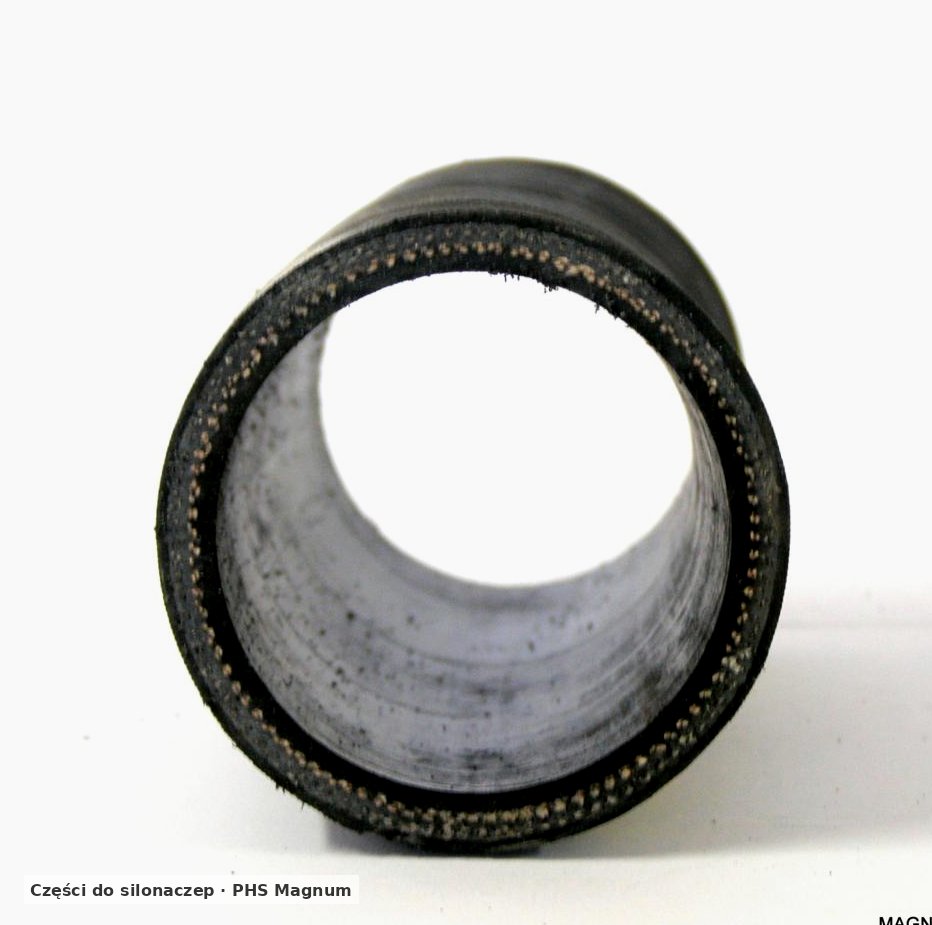
Hoses for pneumatic conveying of abrasive materials (black liner)
| Parameter | Light version DN75 | Reinforced version DN75 |
|---|---|---|
| Application | cement, sand, gravel, chalk, industrial powders | as above — for higher demands |
| Inner layer | SBR, NR rubber, antistatic (copper wire) | BR, NR rubber, antistatic (copper wire) |
| Outer layer | synthetic rubber, textile braid | synthetic rubber, textile braid |
| Wall thickness | 9 mm | 11 mm |
| Temperature range | -40°C to 80°C | -30°C to 80°C |
| Working pressure | max 6 or 8 bar (depending on version) | 12 bar |
| Standard | — | DIN 53516 |
| Additional sizes | DN100 (102 mm) | DN100 (102 mm) |
FDA food-grade hose and CONTI compressor hose (white liner)
| Parameter | FDA food-grade hose DN75 | CONTI compressor hose DN75 |
|---|---|---|
| Application | grain, sugars, foodstuffs, light abrasives | connecting the compressor to the trailer |
| Inner layer | antistatic NR/BR rubber (copper wire), FDA-compliant | EPM/EPDM rubber (white, universal) |
| Outer layer | SBR rubber, textile braid | EPM/EPDM rubber, textile layer, steel spiral |
| Wall thickness | 8 mm | 8 mm |
| Temperature range | -30°C to 70°C | -40°C to 180°C |
| Working pressure | 5 bar | high-pressure hose — matched per unit |
| Standard | FDA | — |
| Additional sizes | DN100 (102 mm) | DN50 (51 mm), DN60 (60 mm) |
Universal industrial hoses
| Parameter | DN50 black | DN50 white | DN60 black |
|---|---|---|---|
| Inner layer | EPDM/SBR rubber | EPDM rubber | EPDM/SBR rubber |
| Outer layer | SBR rubber | textile braid | SBR rubber |
| Wall thickness | 6.5 mm | 8 mm | 6.5 mm |
| Temperature range | -30°C to 80°C | -30°C to 120°C | -30°C to 80°C |
| Working pressure | 12 bar | 6 bar | 12 bar |
| Standard | — | DIN EN ISO 1307 (also DN60) | — |
Direct-supply items (DN25–DN110)
On a next-day basis we source a dozen or so types of utility hose across the full DN25–DN110 range:
- Goodyear hot-air hoses (DN50–DN75), with or without spiral
- 1.4571 stainless steel compressor hoses with a 3" external thread (stainless braid, DIN 2999); DN80, 10 mm wall, range -269°C to 600°C, 25 bar, antistatic; lengths 1.8 m and 2.8 m
- compressed air hoses
- water hoses
- fire hoses
Silo trailer brand compatibility
The pneumatic line standard in European silo trailers is DN75 — which is why we keep this size as a permanent stock item for the abrasive material hose (light and reinforced), the FDA food-grade hose and the CONTI compressor hose. Where the tank configuration or the customer’s installation calls for a larger cross-section, most types are offered in DN100 (102 mm).
- Spitzer SF/SK — aluminium trailers of the SF (non-tipping) and SK (tipping) series. DN75 as the pneumatic line standard; for abrasive loads the reinforced version, for foodstuffs — the FDA hose.
- Feldbinder EUT/KIP — horizontal EUT series trailers and KIP tipping silos (Kippsilo). Food-grade EUT versions in 316L stainless steel require the white FDA hose; on KIP trailers with elevated discharge pressure — the reinforced versions.
- Kässbohrer K.SSK/K.SSL — silo trailers of the K.SSK and K.SSL series. Hose selection as above, by medium and discharge line parameters.
- Other European manufacturers — we serve the remaining silo trailer brands by matching to medium, DN diameter and fitting type; we do not limit ourselves to one manufacturer.
What decides is not the trailer manufacturer but the diameter of the couplings and clamps on the individual unit, and the medium. When ordering, please state the DN, the type of material conveyed and how the end fittings are mounted — we terminate hoses with Storz-system suction couplings secured with GBS clamps or shell clamps.
Hose selection for mixed-brand fleets
Most enquiries reach us from hauliers who run trailers of more than one brand in a single fleet and want to standardise their parts management. We then show them that selecting a pneumatic hose is essentially a brand-independent procedure — it runs through the same three questions, regardless of whose logo appears on the side of the tank.
Question one — the medium. It is the medium, not the manufacturer, that determines the inner layer build. Cement, sand or plastic granulate in abrasive service demands thick, antistatic rubber; a bulk product approved for food contact demands a certified build; the supply line from the compressor — high-temperature rubber. This logic is identical for the aluminium Spitzer SF/SK, the horizontal Feldbinder EUT, the tipping Feldbinder KIP, the Kässbohrer K.SSK and K.SSL, and trailers from other European manufacturers.
Question two — the working diameter and the line. Although most European silo trailers converge on a similar working diameter of the pneumatic line, it is the individual unit, not the series name, that determines the end fitting. That’s why in a mixed fleet you don’t order a hose “for a brand”, but after measuring the DN of the couplings and valve gear on the given trailer. Two trailers from different manufacturers can take the same hose if their cross-section and termination system match.
Question three — the end fittings, i.e. how they are mounted. This is where brands most often differ in detail: the spacing and type of the fittings the suction coupling connects to can be characteristic of a given tank design. The hose is therefore selected so that the body matches the medium in its material parameters, and the terminations match the actual Storz fittings and clamps on the unit. In practice this means the same hose body can be terminated differently for different trailers in the fleet.
The result is that a fleet made up of several brands doesn’t need several separate “hose catalogues”. It needs one, read by medium and line, with flexible end-fitting selection. This approach tidies up procurement and shortens downtime, because the storekeeper isn’t looking for a “Spitzer item” or a “Feldbinder item”, but by function and diameter.
The role of the central warehouse and network logistics
A multi-brand catalogue only makes sense when a single supply point stands behind it instead of scattered stocks. The central warehouse of the PHS Magnum network plays exactly that role: it consolidates items common to many brands in one place, instead of duplicating them across separate manufacturer-assigned locations. For a customer with a mixed fleet this means one source, one contact and a consistent quality policy for hoses going onto trailers of different designs.
Logistics follows from this consolidation. The items that genuinely move in day-to-day fleet service — light and reinforced abrasive hoses, food-grade, compressor and universal industrial hoses — we keep available off the shelf, because they rotate regardless of which brand of trailer they end up on. Rarer, specialised items we run on a direct next-day supply model instead of freezing them on the shelf. This split between rotating stock and sourced stock is a deliberate decision: it lets us serve a wide cross-section of brands without physically holding the full catalogue.
Centralisation also makes compliance control easier. When hoses for all brands pass through one warehouse, it is easier to make sure the material parameters match what is declared and that an industrial hose never accidentally ends up in a food-grade line. Proximity to the A4 motorway completes the logistics picture — the same point handles domestic shipping, export to EU countries and personal collection, regardless of which brand of trailer the part is destined for.
What to watch for across brands
Although the selection procedure is shared, in a mixed fleet it is worth knowing the nuances that tend to be characteristic of the individual designs:
- Spitzer SF/SK — with light aluminium tanks, the key is matching the abrasive hose version to the real intensity of the duty; with frequent discharge of abrasive materials the reinforced version usually works out better than the light one.
- Feldbinder EUT/KIP — in stainless steel food-grade versions, keep the food line strictly separate from the industrial one and never use a black hose for a certified product; in tipping silos, match the build to the elevated operating conditions of the pressure line.
- Kässbohrer K.SSK/K.SSL — treat like any other European silo trailer: start with the medium and a measurement of the line diameter, and match the body and end fittings to the actual valve gear, not the series name.
- Other brands / other European manufacturers — the same functional approach; the absence of “per-logo” catalogue data is no obstacle, because the measurement and the medium are decisive anyway.
The common denominator for all brands stays the same: you don’t select a hose “for a manufacturer”, but for what the hose actually has to convey, in which line and with which termination. The rest is a matter of measurement and end-fitting matching — and that is exactly the work we take on when a customer doesn’t want to multiply suppliers for each brand separately.
Hose functions in the line — a common language for the whole fleet
To compare hoses across brands, it helps to first break the pneumatic line down into functions that repeat in every silo trailer, regardless of manufacturer:
- The material-conveying hose — this is what carries the fluidised load from the tank to the discharge point. In a mixed fleet it is the fastest-wearing component, because it works in contact with an abrasive or food-grade medium.
- The supply hose from the compressor — delivers air to the line. Its selection is governed by temperature range and resistance to pulsation, not by trailer brand.
- Auxiliary lines — sections for air, water or workshop applications, common to all designs.
When we speak to the whole fleet in the same language of functions, rather than the trade names of individual manufacturers, it is easier to plan stock and servicing. The storekeeper orders “a hose conveying abrasive material in a given diameter”, not “a hose for a specific model” — and uses the same item across several brands at once.
Standardising parts management in a multi-brand fleet
For fleets with trailers from several manufacturers, tidying up hose procurement brings concrete operational benefits:
- Fewer stock items — one hose type in one diameter replaces several “branded” equivalents, because the difference comes down to the end fittings, not the body.
- Simpler replacement planning — the criterion is function and medium, so the workshop can predict wear regardless of which trailer the hose happens to be working in.
- One quality standard — with supply from a single source it is easier to keep consistent material parameters across the whole fleet.
- Faster response — rotating items are off the shelf, and rare ones are sourced next-day, so the downtime of one trailer doesn’t block the whole fleet.
This approach works especially well where the haulier deliberately avoids splitting deliveries among separate suppliers for each brand. Instead they run one service relationship, and the matching to the specific unit — diameter, medium, end fittings — is done by us, at ordering time or during an inspection.
Diagnostics and replacement regardless of brand
Assessing hose condition is also a brand-neutral procedure. Regardless of which trailer the hose works in, we look at the same wear symptoms: a pressure drop in the line, extended discharge time, visible dusting, hardening or cracking of the rubber outside its temperature range, and loss of continuity of the antistatic wire. Each of these symptoms means the same thing on a Spitzer, a Feldbinder and a Kässbohrer, because it stems from the physics of flow, not from the brand’s design.
The replacement interval remains individual and depends on the medium, pressure and intensity of the duty — which is why we don’t quote made-up service-life figures. We carry out diagnostics and selection unit by unit, treating the fleet as a set of pneumatic lines to maintain, not as a set of logos. As a result, the owner of a mixed fleet gets one consistent servicing policy for all trailers.
How we put together an order for a mixed fleet
To get the selection right from the first order, we ask for three pieces of information for each unit — the same for all brands:
- Medium — what actually passes through the hose: abrasive material, a food product, or air from the compressor. This determines the body build.
- Line diameter — measured on the given trailer, not read off a series name. Two trailers from different brands can have the same cross-section or a different one.
- How the end fittings are mounted — what fittings and clamps are on the unit, so the Storz-system termination can be matched.
With this set in hand, we assemble the order so that trailers of several brands in the fleet receive hoses of a consistent material standard, differing only in the terminations where the specific valve gear requires it. That is the essence of the hub approach: one catalogue, one source, matching at the level of the individual unit.
In a mixed fleet there is also the question of documentation consistency. When hoses for all trailers come from one point, it is easier to keep a unified replacement record and link it to pneumatic line inspections — whether the unit in question is a Spitzer, a Feldbinder, a Kässbohrer or a trailer from another European manufacturer. Such a record also helps when planning stock for the next season, because it shows which hose functions wear fastest in a given fleet.
Summary for fleet managers
If you manage a fleet made up of trailers from different manufacturers, the key takeaway from this page is simple: you don’t buy a pneumatic hose “for a brand”, but for its function, medium, diameter and termination. The trailer brand affects at most the detail of the end fittings, not the hose body. That’s why one well-organised cross-brand catalogue — supplied from a central warehouse and read comparatively across brands — serves the whole fleet more efficiently than scattered stocks assigned to individual manufacturers. The rest, i.e. measurement and matching to the specific unit, we take on ourselves.
The most common questions from multi-brand fleets
In conversations with hauliers running fleets of several brands, a few threads recur that are worth settling up front:
- Will one hose serve trailers from different manufacturers? The body — yes, as long as the medium and working diameter match; the difference usually comes down to end fittings matched to the given trailer’s valve gear.
- Do we need to keep separate stock for each brand? No. Stock is planned by function in the line and by medium, not by logos; the same type rotates between trailers from different manufacturers.
- How does selection differ between an aluminium and a steel trailer? The tank material doesn’t change the hose selection principle — what matters is what flows through the hose and how it is terminated.
- What about trailers from brands outside this description? We proceed identically: measure the diameter, establish the medium, match the end fitting; the lack of a separate “per-logo” data sheet blocks nothing here.
A short comparative conclusion: the differences between brands in pneumatic hose selection are real, but they lie in the valve gear and end fittings, not in the heart of the hose. The body is selected by the same method for a Spitzer SF/SK, a Feldbinder EUT/KIP, a Kässbohrer K.SSK/K.SSL and trailers from other European manufacturers — which is exactly what makes the cross-brand catalogue a practical tool for the whole fleet.
Why a cross-brand view rather than a single brand
The specialist pages of our network describe hoses from the perspective of one design and one trailer family — convenient when you’re looking for information on a specific unit. This page deliberately does something different: it looks at the same range from a bird’s-eye view, as a shared resource for many brands at once.
This perspective has several practical advantages for a fleet manager:
- it shows where brands converge (body, medium, line physics) and where they diverge (valve gear, end fittings),
- it lets you plan one stock instead of several parallel ones,
- it gives a point of reference when part of the fleet switches to another brand and the servicing policy has to stay consistent,
- it makes it easier to talk to one supplier instead of negotiating for each logo separately,
- it shortens response time, because decisions are made based on function and medium rather than hunting for a brand-assigned item,
- it lets you keep one DN75 hose reference for Spitzer SF/SK, Feldbinder EUT/KIP and Kässbohrer K.SSK/K.SSL vehicles working on a similar medium,
- it simplifies stocktaking, because instead of separate lists for each brand you keep one list of hose types and end fittings for the whole fleet.
In other words, the more diverse the fleet, the more value a catalogue read cross-brand has. A single brand is the view from the trailer’s level; the PHS Magnum network gives the view from the level of the whole fleet — and it is precisely that view which most often decides how efficiently you maintain the pneumatic line across all your silo trailers.
One methodological caveat to finish: this page is no substitute for measurement. Cross-brand comparisons help plan stock and understand where designs converge, but the final selection always follows from the actual diameter and valve gear on the given unit. That’s why the best first step for a mixed fleet is to send us a list of trailers with the medium and line diameter — on that basis we put together a consistent hose stock covering all the brands in the fleet.
Chorula warehouse
We keep the core DN50–DN100 hose range (light and reinforced abrasive, FDA food-grade, CONTI compressor, universal industrial) in stock at the PHS Magnum warehouse in Chorula near Opole, 4 km from the A4 motorway. Special items — Goodyear hoses, 1.4571 stainless, fire hoses — we source via direct next-day supply.
We don’t warehouse “a catalogue on a shelf” — we hold what genuinely moves in servicing fleets of various brands, in quality and build consistent with the declared material parameters. The hose replacement interval depends on the medium, pressure and intensity of duty, so we don’t quote made-up service-life figures — selection and diagnostics are handled individually.
- Poland — courier shipping
- EU — delivery to European Union countries (incl. Germany, Austria, Czechia)
- Personal collection — Chorula warehouse near Opole, 4 km from the A4
Hose selection for a specific load and trailer: PHS Magnum service. Full scope of services: magnumchorula.pl/serwis/ .
Specialist portals
Detailed pneumatic hose catalogues for specific brands are maintained on our specialist portals:
- Spitzer — pneumatic hoses for SF/SK series silo trailers: spitzer.pl/czesci-zamienne/weze-pneumatyczne/
- Feldbinder — pneumatic hoses for EUT/KIP silo trailers: feldbinder.pl/czesci-zamienne/weze-pneumatyczne/
Related categories
- Storz system — couplings and suction fittings for terminating hoses
- Hose clamps — GBS clamps and shell clamps for hose mounting
- Check valves — check valves in the pneumatic line
- PTFE ball valves — valves for air in the pneumatic line
- Full spare parts catalogue
Author: Aleksy Pasternak — Managing Partner at PHS Magnum, 20 years in the industry, internal auditor ISO 9001:2015 (DEKRA).