Two service tools for the whole fleet
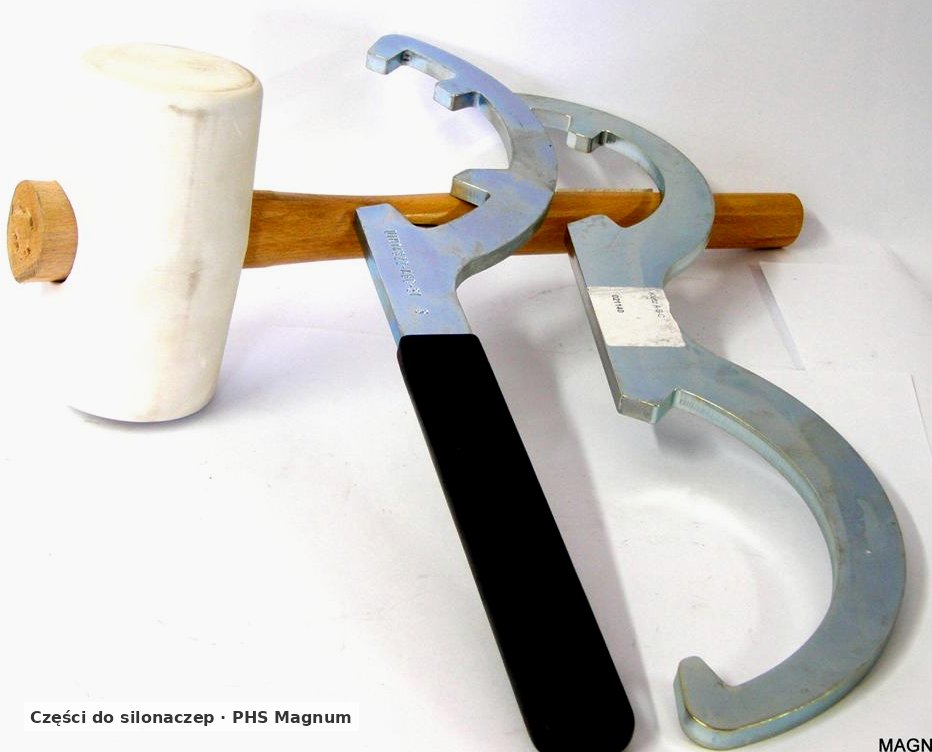
Day-to-day operation of a silo trailer is not just the vehicle and its system, but also a set of simple tools without which the driver’s and technician’s work becomes tedious. Two of them are indispensable around the Storz system and the silo itself regardless of trailer brand: a rubber mallet for tapping the tank and a wrench for Storz couplings. They may seem like trivial accessories, but their quality translates directly into the efficiency and safety of discharging bulk materials and PE/PP granulate.
We look at these tools from the perspective of the entire fleet we service. During conveying, material can settle on the silo walls or cone — gentle tapping with a soft mallet helps it slide down without risking damage to the shell, because rubber neither dents nor scratches the plating. An ordinary hard hammer risks denting the tank and a costly repair, which is why a white natural rubber head is the tool of choice. The Storz wrench, in turn, allows couplings to be connected and released with confidence — after working under pressure they can seize tightly, and improvised tools then damage the coupling lugs or the seal, leading to leaks.
Specification
Rubber mallet for tapping the silo
| Parameter | Value |
|---|---|
| Head material | white natural rubber |
| Handle | wood |
| Weight without handle | 750 g |
| Application | tapping the silo of a silo trailer |
White natural rubber is soft enough not to damage the shell or the welds, yet resilient and resistant to crumbling — it leaves neither chips nor staining marks, which matters for hygiene on food-grade trailers.
Wrenches for Storz couplings
| Parameter | Value |
|---|---|
| Material | high-strength galvanised steel |
| Compatibility | universal for sizes A, B, C |
| Classic version | double-ended |
| Single-ended version | with insulated handle (soft antistatic rubber) |
High-strength galvanised steel provides durability and corrosion resistance under intensive use in the field. The wrench’s universality (A, B, C) means one tool handles most Storz connections.
Brand compatibility
Both tools are universal and do not need matching to a specific series or trailer model year — Storz is a standard shared across the entire network we service:
- Spitzer (SF/SK) — wrenches for discharge couplings, mallet for tapping the silo.
- Feldbinder (EUT/KIP) — tapping assists the pneumatic discharge of the horizontal EUT tank and of poorly flowing materials in the KIP.
- Kässbohrer (K.SSK/K.SSL) — Storz wrench for discharge connections.
- Other brands — wherever the system uses Storz A/B/C couplings.
In fleet practice it is a good habit to assemble a standard Storz tool set for every trailer: one universal wrench (classic double-ended or single-ended with insulated handle) plus a rubber silo mallet. For fleets working with PE/PP granulate, where the electrostatic risk is elevated, it is worth adopting the wrench version with a soft antistatic rubber handle as the standard.
Chorula warehouse
We keep rubber mallets and Storz coupling wrenches in stock at our warehouse in Chorula near Opole (4 km from the A4 motorway, approx. 180 km from the German border) — both tools usually off the shelf. It is a small cost that eliminates situations where a driver on the road grabs a random tool and risks damaging the coupling or the shell. We recommend periodic inspection and replacement of worn items — a worn mallet head or a wrench with abraded handle insulation. Courier shipping across Poland, the EU and the DACH market; grouped orders with the other Storz accessories are possible. To choose the right version and check availability — ask for a quote.
Selecting tools for mixed-brand fleets
The rubber mallet and the Storz wrench are tools that simply do not recognise brand boundaries — and that is exactly why in a mixed fleet they work best as one shared service kit. Storz couplings in sizes A, B and C appear on the discharge systems of Spitzer SF/SK, Feldbinder EUT/KIP and Kässbohrer K.SSK/K.SSL, so the same universal wrench connects and releases couplings regardless of the logo on the tank. Tapping the shell with a soft mallet does not depend on the manufacturer either — what counts is the head material, not the silo design.
Differences between brands concern rather how often and where these tools are reached for. On Spitzer SF and SK designs, tapping supports material flow towards the outlets during pneumatic discharge. In the horizontal Feldbinder EUT tank, where emptying relies solely on pneumatics, caked or bridged product can slow the cycle noticeably, so the mallet tends to be used more often; in the tipping KIP silo, tapping helps with poorly flowing materials despite the tank’s inclination. On Kässbohrer K.SSK and K.SSL silo trailers, the Storz wrench serves the same discharge connections. Despite these differences, the equipment choice remains identical: one universal A/B/C wrench plus a white natural rubber mallet for every trailer.
From the perspective of the central warehouse in Chorula, this means a simple procurement model: we keep both tools permanently on offer and pick them together with the rest of the Storz equipment for the entire network of brands. The network’s logistics allow a complete service tool set to be shipped to any trailer without sorting orders by manufacturer, and for fleets working with PE/PP granulate we recommend the wrench version with a soft antistatic rubber handle as the standard.
It is worth remembering that both tools are inexpensive, while their absence or poor choice genuinely prolongs discharge and puts more expensive system components at risk. An improvised hard hammer dents the shell, and a random wrench damages the coupling lugs or the coupling seal — regardless of whose logo the trailer carries. That is why in a mixed fleet we treat assembling a standard service kit for every vehicle as part of the maintenance routine, not an optional expense. A worn mallet head or a wrench with abraded handle insulation is replaced on schedule, before it fails on the road.
What to watch for across brands
- Coupling size, not brand — the A/B/C wrench handles Spitzer SF/SK, Feldbinder EUT/KIP and Kässbohrer K.SSK/K.SSL connections without matching to a series.
- Tapping intensity — with a pneumatic horizontal tank the mallet tends to be used more often than on tipping trailers; check the head for worn rubber.
- Food-grade hygiene — white natural rubber does not stain the shell, which matters especially in fleets running food-grade trailers.
- Electrostatic risk — with PE/PP granulate in a mixed fleet it is worth standardising on the wrench version with an antistatic handle.
- Condition of the wooden handle — a loose or cracked head seating is caught by periodic inspection, regardless of trailer brand.
- Wrench zinc coating — abrasion can produce rust bloom; high-strength steel remains functional, but a wrench with a heavily worn coating is worth replacing.
The practical conclusion for a mixed-fleet manager is simple: instead of keeping separate tool sets for each brand, one standard locker kit is assembled — a universal wrench and a white rubber mallet — and replicated across the entire fleet. Standardisation also lowers stock cost and streamlines inspections, because the technician evaluates the same two items everywhere against the same wear criteria.
Specialist portals
Descriptions of Storz hammers and wrenches prepared for specific trailer brands are available on our portals: Spitzer and Feldbinder .
Related categories
Author: Aleksy Pasternak — Managing Partner at PHS Magnum, 20 years in the industry, internal auditor ISO 9001:2015 (DEKRA).